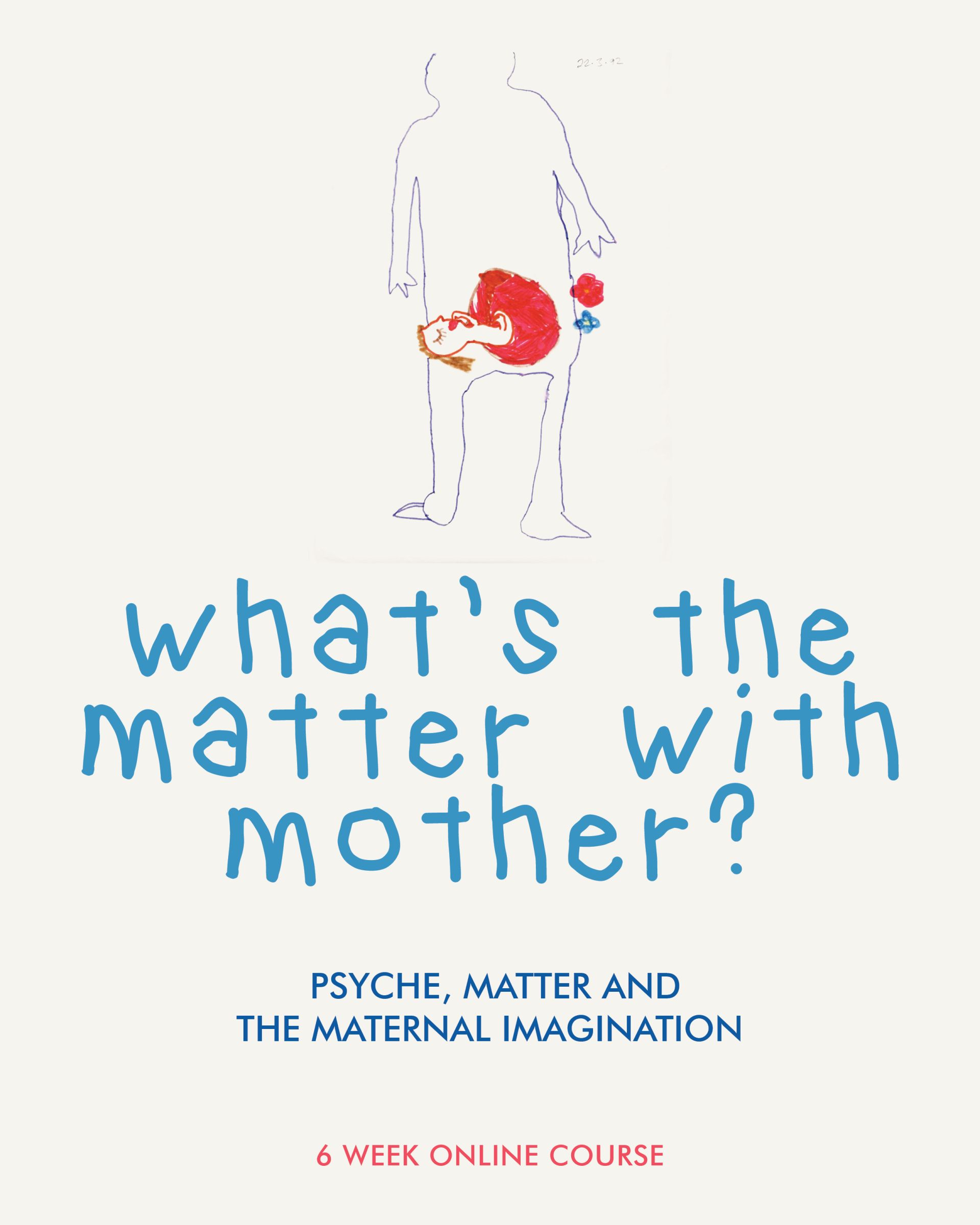
September 12th 2026 with "What's the Matter with Mother" - 6-Week Course
March 13th 2027 "Oedipus Revisited" - 8-Week Course
September 11th 2027 "The Wound and the Eye" - 6-Week Course
Three courses, exploring and revisioning the parenting myths that have shaped almost a century and a half of psychoanalytic practice as their founding mythologies, and the idea of the original wound. When Freud developed his psychoanalytic therapy, he got one thing fundamentally right - we, as humans, live through, by, and as mythology. However, with his focus on Oedipus and Electra as one of the only mythologies shaping human psyche (and indeed, human sexuality) he created a culture where our conditions are constantly brought back to, and blamed on, our childhoods and the ‘real’ mother and father.
Our immediate origin story has been literalized as developmental psychology: an imaginative full stop to our entire potential for understanding our complexes, woundings and ‘recovery’ in the grander context of our lives and fate. By placing the enormity of archetypal projections onto two ordinary humans (whether ‘good enough’ or flawed), and the healing of our woundedness as precursor to entering the world, we stunt our potential for depth and the greater imagination needed to meet the psyche on its own terms, and to enter life fully.
Courses Descriptions
Starts 12 September 2026
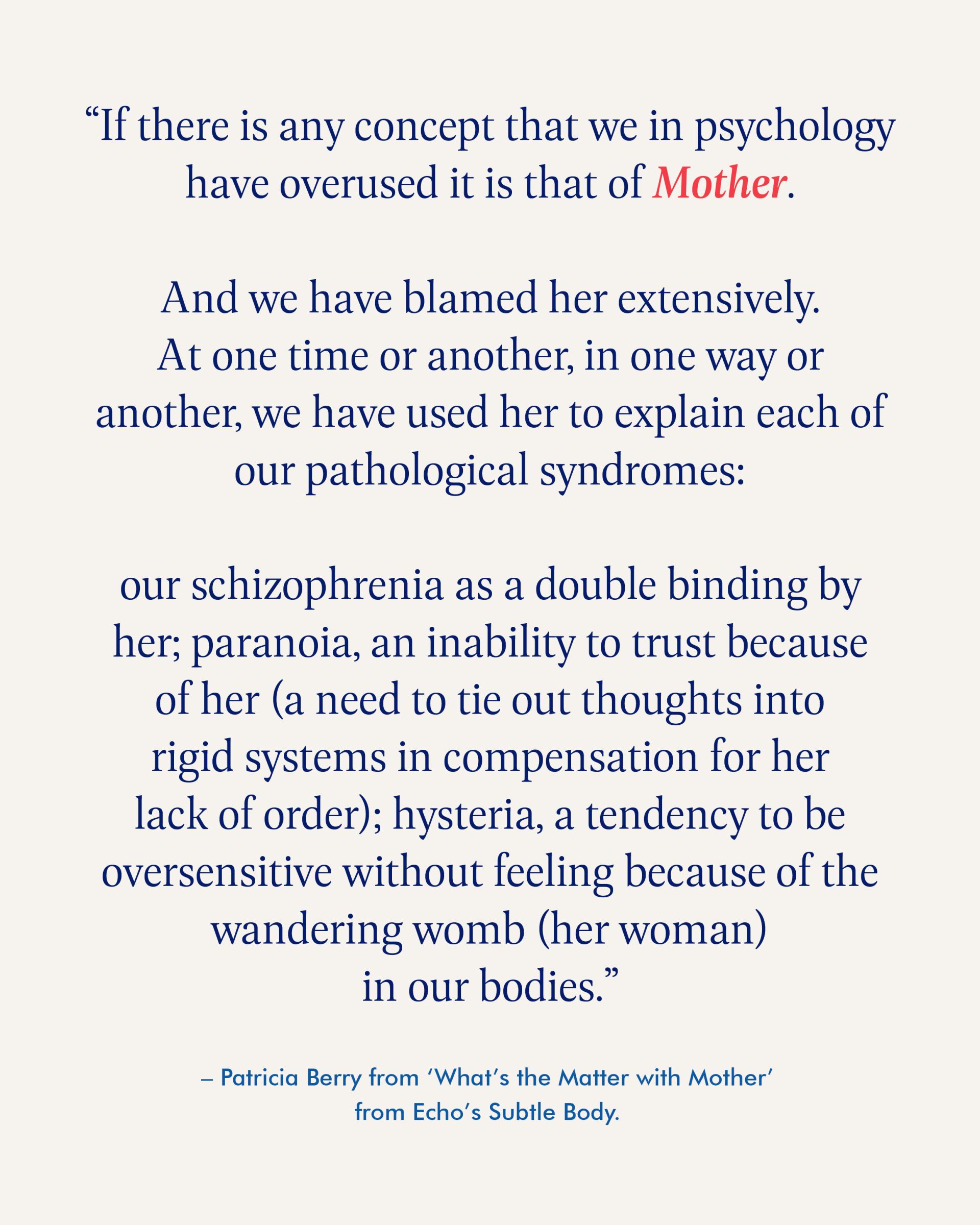
Beyond the personal mother, we examine the Great Mother as an organizing principle of psyche, tracing how she governs the territories of innocence and injury, nourishment and deprivation, descent and return.
The maternal archetype is not simply protective; it is also demanding, destructive, and inseparable from the cycles of chaos and order through which psychological life takes shape.
We explore these themes through the mother-daughter dyad of Demeter and Persephone, and later through Eve, the mythic mother of humanity.
Somatic sessions form an essential part of this course, offering a way to investigate how our image of the maternal is lived and related to and through the body. By attending to the felt assumptions we take for granted, we begin to encounter the unconscious literalisms that ground our experience of self, world, and reality itself.
More details here.
Starts 13 March 2027
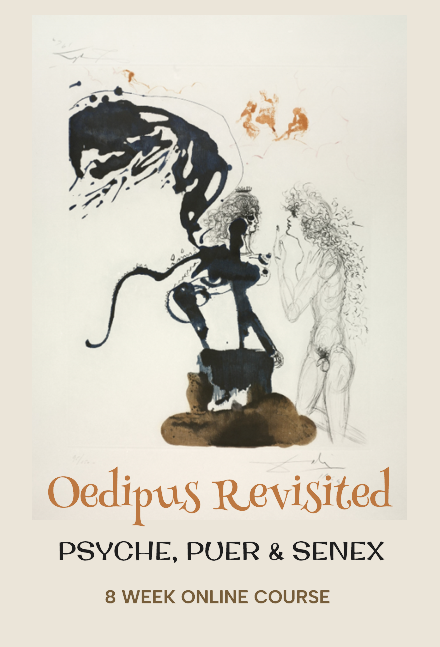
The senex and puer aeternus are not diagnoses but complementary archetypal forces. The puer
brings possibility, imagination, eros, and renewal; the senex gives form, patience, and the ability to
endure contradiction. Severed from one another, the senex becomes rigid law and the puer remains
ungrounded fantasy. Their tension is creative rather than pathological.
This eight-week course revisits the Oedipal myth as an archetypal field rather than a developmental
verdict. Through Jungian and post-Jungian theory, imaginal work, and embodied exploration, we
investigate how fathering operates within psyche: as authority, witness, limit, inheritance, and
orientation toward the world. Embodiment becomes essential here, countering the tendency to
reduce psyche to disembodied “father-thinking” alone, or the avoidance of it. To return senex and
puer to the body is to restore their relation to one another, to the feminine matrix of psyche, and to
the polis where myth is not merely interpreted, but lived, enacted, and transformed
Starts 14 August 2027
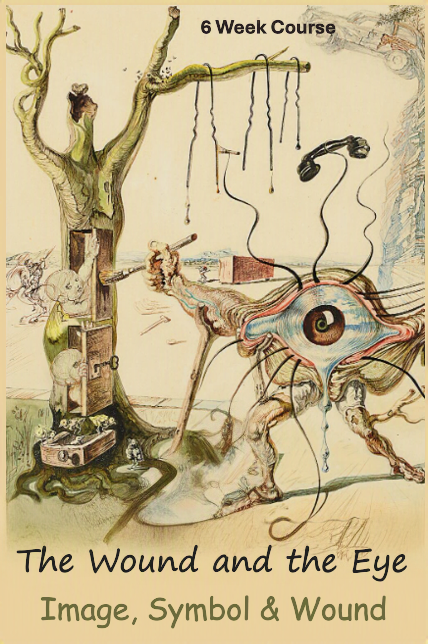
This course begins from an archetypal premise: the soul does not seek health or resolution, but
depth. Psyche is inherently pathologising—not as an illness to be cured, but as a mode of seeing
that intensifies life through image, symptom, and wound. Drawing on James Hillman's The Wound
and the Eye, we approach psychological wounding as formative, shaping perception, desire, and
style.
Central to this inquiry is the archetype of the puer, whose sensitivity, openness, and longing for
immediacy are inseparable from vulnerability and injury. If worked with rather than defended
against, the wound refines the eye through which the world is encountered, even as it exposes the
puer to repetition, inflation, and collapse. Rather than treating these dynamics as failures, we
explore them as tensions that call for a broader imagination and a more expansive capacity for
embodiment.
We will also explore traumophilia—the soul's attraction to
what wounds, repeats, or remains unresolved—not as a pathology to be eliminated, but as an
expression of psyche's movement toward depth, eroticism, and our capacity for religious
experience
Courses Overview
To work with images without literalizing, resisting, or disembodying them is an alchemical
discipline that enlarges imaginal capacity—the ability to see through what is arising rather
than be possessed by it, or to repress it (another kind of possession). Our ability to feel
fully what is arising and present, without taking it personally, is the muscle we being to
develop when we can see begin to see our experience in relation to the animate and
archetypal.
Seeing archetypally enables the release of some of the impact of our projection from the
object that carries it, a processes that co-arises with the body’s ability to know instinctually,
experience life (including its hardships) erotically, and respond with creativity. The pain of
our desires and suffering galvanizes this process. Through it, eventually, body becomes
sacred and, no longer burdening the world with the unconscious expectation of the
archetypal god, we can begin the journey of actual relationship - to life, the self, and the
other - with aliveness and appreciation for all that is.
Myth gives this process a human face in the story of Psyche and Eros. Psyche, is the mortal
portion of beauty who the god Eros falls in love with, accidentally pricking himself with
his own arrow. Their union is not immediate or idealized; it unfolds through longing,
frustration, betrayal, and commitment. Eros names the forward movement of desire and
its inherent inhibition that draws us into relationship (both inner and outer). Psyche names
Soul - the view to see through, and to touch the ineffable beauty of of life in its full display.
To stay with the trouble of the emergent, the labor of suffering, and the task of
differentiation, and appreciate them with aesthetic sensibility, is to make real love, beyond
fantasy, possible. Psyche and Eros’ eventual marriage does not bypass difficulty; it is
forged through it.
In this way, inner marriage (alchemically known as heiros gamas), and the work of
attaining it does not replace outer relationship with inner—it makes it possible.
This series of courses engages major themes of psychotherapeutic practice - starting with
some of the founding myths of psychology that began with Freud, to a post-Jungian
perspective of major themes such as mother, farther, dark fantasy and moods, and the
wound.
Theory is supported by artistic and somatic strategies to open as to a depth of
image and emergent experience
______________
Year One consists of two 8-week courses and one 6-week course, beginning with an
exploration and revisioning of the myths of mother and father through a Jungian and post
Jungian lens:
What's the Matter with Mother and Oedipus Revisited. To mythologize
these figures in their complexity is to explore how they constellate the child, the hero, the
innocent, the underworld, and the puer aeternus in relation to the senex and the fathering
spirit. Through the work we deepen the psychic ground necessary to see though the
surface narrative of our experience, and cultivate our insighting witness, to support the
conditions through which suffering and complexes may reveal both their necessity and
their telos.
The Wound and the Eye follows what is perhaps a simultaneously enormous theme
coming out of the developmental mode of psychology and its Christian inheritance - that
of the original ‘wound’, or childhood infliction. Rather than fixating on woundedness or
the perceived injustices of childhood as deviations from an imagined perfection, we turn
our attention to the soul’s impulse and necessity to pathologize. By developing the
capacity to descend beneath suffering’s more superficial forms, we uncover how trauma
might not only deepens us, but also holds intimate keys to our eroticism and aliveness.
______________
Registration and Bookings
First Course Starts Saturday, September 12, 2026
Payment Options
Access to Course Platform with all learning materials
Access to the live zoom sessions and recordings
Access to the facilitated private course forum
______________
Faculty
Andrew Samuels
Elizabeth Nelson
Elizabeth Éowyn Nelson PhD, faculty of Pacifica Graduate Institute since 2003, teaches
and speaks internationally and has published numerous scholarly essays on
subjects including animals, dreams, feminism, film, mythology, research,
somatics, and technology. Dr. Nelson’s books include Psyche’s Knife (Chiron, 2012), The
Art of Inquiry (Spring, 2017), coauthored with Joseph Coppin, and The Art of Jungian Couple Therapy,
coauthored with Anthony Delmedico (Routledge, 2025), and Weird Writing (in press). A professional writer and editor for four
decades, she coaches aspiring authors across multiple genres. www.elizabethnelson-phd.com
Nan McAughey
Siobhan Brodie
Professor Giovanna Colombetti
Nico Athene
Stephen Anthony Farah
______________
Join Our Newsletter
Explore
About the Centre
Site Design by Sean Corey.