Oedipus Revisited

Father, Son, and the Myth That Shaped Psychoanalysis
For more than a century, one myth has been used to explain who we are. This course asks:
 What it was really trying to tell us?
8 weeks · Starts: TBC
**Note**
Course start dates and contents still to be finalised
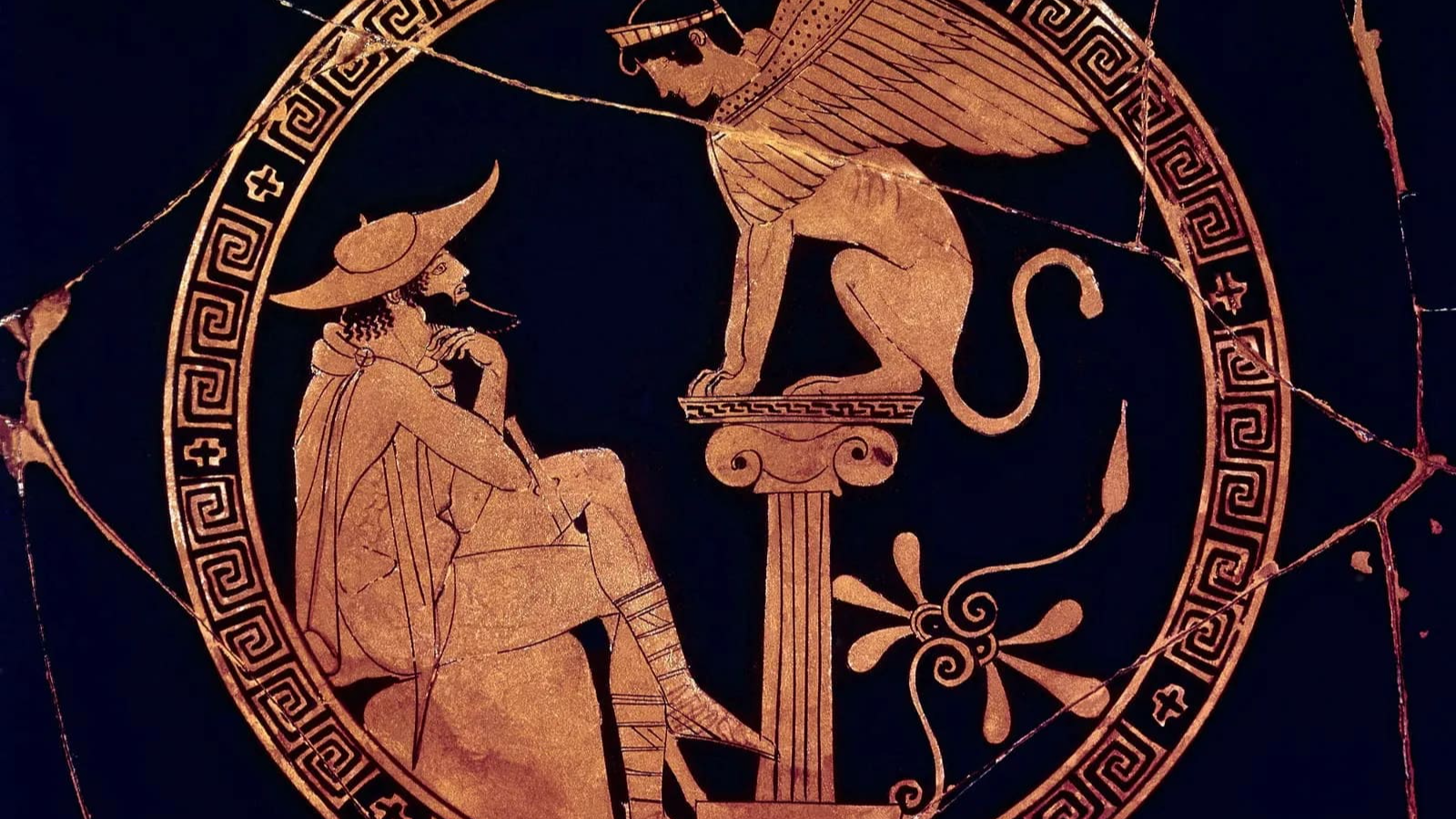
Who taught you what a father is? Not your own father, but the idea of one. The authority you still answer to, the judgement you still brace for, the permission you’re still waiting on. Where did it come from? And why does it still have so much power over a life that has long since left childhood behind?

When Freud built psychoanalysis, he got one thing fundamentally right: human beings live through, by, and as mythology.

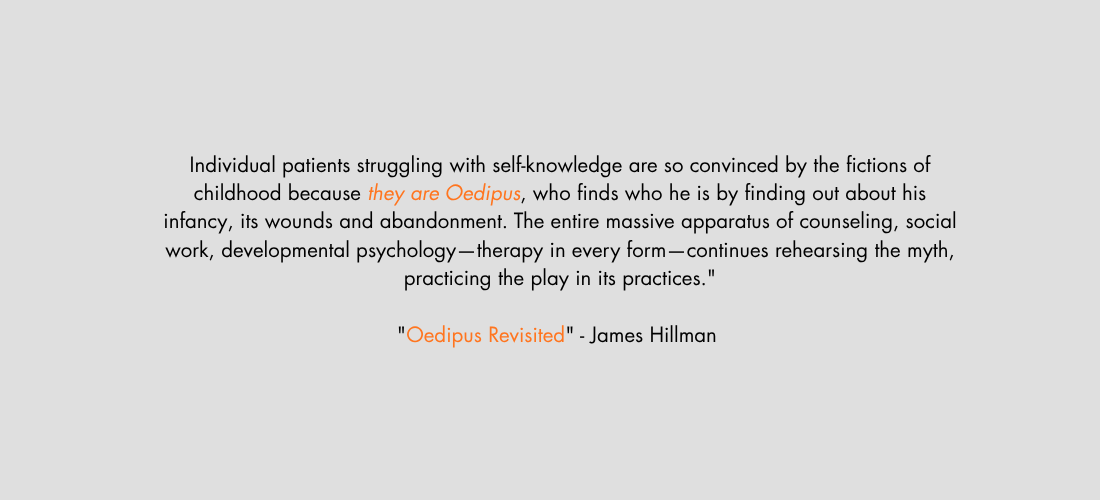
But he chose one myth above almost all others. Oedipus became the story of the human psyche. Over time, that story hardened into a verdict. Our complexes, our wounds and our desires were traced back, again and again, to two ordinary people: the “real” mother and father.


The myth was turned into developmental psychology, and that turn put an imaginative full stop on our capacity to understand ourselves in the larger context of our lives and fate.

Returning to the myth


Oedipus Revisited
returns to the myth not as a diagnosis, but as an archetypal field. Over eight weeks, we explore how fathering lives within the psyche as:


Authority: the inner law we obey or rebel against

Witness: the gaze we seek, or fear

Limit: what holds us, and what confines us

Inheritance: what is handed down whether we want it or not

Orientation: how we learn to face and enter the world
Course Details

Live Sessions


XXX

______________

Workshops

XXX

______________

Pre-recorded Sessions


XXX

______________

Presentations Details


XXX


______________

Registration and Bookings


Course Starts: TBC

Payment Options TBC

Access to Course Platform with all learning  materials
Access to the live zoom sessions and recordings
Access to the facilitated private course forum

Questions?  Contact Info@Appliedjung.com

Faculty

Andrew Samuels

Professor Andrew Samuels is a relational Jungian psychoanalyst, professor, activist and political consultant (including to Britain's National Health Service). He founded or co-founded many organisations within the 'psy' field, including Psychotherapists and Counsellors for Social Responsibility, Psychotherapy and Counselling Union, Analysis and Activism, International Association for Jungian Studies, and the Confederation for Analytical Psychology. Elected Chair of the UK Council for Psychotherapy 2009-2012 and has worked as Consultant for Routledge's Analytical Psychology List since 1984.   His many books have been translated into up to 21 languages. These include Jung and the Post-Jungians (1985), The Plural Psyche (1989), The Political Psyche 1993), Politics on the Couch (2001), Persons, Passions, Psychotherapy, Politics (2015), and A New Therapy for Politics? (2018). His most recent book (2025), published by Routledge, is titled Reflecting Critically on the Political Psyche: Therapy, Testament and Trouble in Psychoanalysis and Jungian Analysis. Also in 2025, a new edition of The Father: Contemporary Jungian Perspectives was published. A selection of video lectures and 'rants' is available on www.andrewsamuels.com

Elizabeth Nelson

Elizabeth Éowyn Nelson PhD, faculty of Pacifica Graduate Institute since 2003, teaches and speaks internationally and has published numerous scholarly essays on subjects including animals, dreams, feminism, film, mythology, research, somatics, and technology. Dr. Nelson’s books include Psyche’s Knife (Chiron, 2012), The Art of Inquiry (Spring, 2017), coauthored with Joseph Coppin, and The Art of Jungian Couple Therapy, coauthored with Anthony Delmedico (Routledge, 2025), and Weird Writing (in press). A professional writer and editor for four decades, she coaches aspiring authors across multiple genres. www.elizabethnelson-phd.com 

Nan McAughey

Nan McAughey channelled her love for intensity and altered states through drama and choreographic theatre, working for most of the first half of her life with the Market Theatre Laboratory and the Moving into Dance Company in Johannesburg. A 10 year film, television, stage and community theatre career culminated in a Master's with distinction in Site-specific Living Heritage and Ritual Drama that challenged patriarchal and apartheid constructs of identity. Her final production before she left the public stage was a techno-ritual opera called “earthdiving", that she wrote and co-directed with BBC director Nancy Diuguid, for the Spier New Opera Season in 2002. After having a child, her hands-on practice of the energy medicine Jin Shin Jyutsu extended to integrate intensive studies in Archetypal Psychology with the Tamboo Academy. Co-facilitating many of their workshops, and evolving new work with Tamboo Tygress, she expanded her practice into Imaginalbody Therapy, that currently includes creative processes, dance, contact improvisation, ritual, and excursions into wild nature.


Siobhan Brodie

Siobhan Brodie is an Archetypal Therapist, Teacher, Relationship Counsellor and Conscious Body Therapist in the Tamboo Academy. Her lifelong curiosity has taken her through university degrees and further studies, across landscapes and cultures, and deep into the psyche's interior. Her work with individuals, couples and groups explores image, ritual, mythology, pathology, beauty, art, movement and the erotic imagination.     Together with her thiasos, she co-facilitates workshops and therapist-training programmes, weaving psychotherapy with theatre, meditation, movement and ritual. Her dedication to the imaginal takes her regularly to India and other sanctuaries, where she is as likely to be found in maenadic ecstasy as enjoying kulfi - or both together.

Professor Giovanna Colombetti

Giovanna Colombetti is Professor of Philosophy in the Department of Social and Political Sciences, Philosophy, and Anthropology (SPSPA) at the University of Exeter, where she coordinates the interdisciplinary research cluster Mind, Body, and Culture within EGENIS (The Centre for the Study of the Life Sciences). She works primarily in the philosophy of embodied and situated cognition, and the philosophy of emotion, drawing on different traditions and disciplines—such as phenomenology, analytic philosophy, theoretical and experimental psychology, neuroscience, and performance and material-culture studies. Her first monograph, The Feeling Body: Affective Science Meets the Enactive Mind (published in 2014) proposed a dynamical and enactivist reconceptualization of affective phenomena. Since then, Giovanna’s research has focused on the notion of situated affectivity, and she has recently completed another book on this topic, titled Feeling with Things: Toward a Theory of Material Affective Scaffolding (forthcoming with MIT Press in 2027).

Nico Athene

Nico Athene holds a BA in Social Anthropology from the University of Cape Town, Athene began her inquiry into embodiment and the power of social imagining, developing it further through a master’s degree in fine arts at the University of the Witwatersrand, awarded with distinction. Her thesis, Approximating Unknowns as an Ethics Towards Encountering Difference, explored archetypes of the ecological body and included improvised scenes of dialogue and enmeshment with (in)animate landscapes as a means of deconstructing colonial subject-object relations. She now works as a visual artist (painting and performance) and facilitator of psychosocial inquiry through the body. Athene has performed as a professional dancer in multiple ritual productions, including several by Brett Bailey and a collaboration with Tossie van Tonder, and has exhibited her work in numerous galleries. She has taught privately, at the University of the Witwatersrand under a grant from the Centre for the Humanities and Arts, at Baard University, and for the Centre for Applied Jungian Studies. Her ongoing study of butoh and post-Jungian theory continues to inform her exploration of the imagining body as a mode of knowing, and as the site through which we meet the animate cosmos and the mysteries of soul.

Stephen Anthony Farah

Stephen Anthony Farah, MA is the co-founder and Head of Learning and Research at The Centre for Applied Jungian Studies South Africa. He is the past co-Chair of the International Association of Jungian Studies and served on the IAJS Executive Board for nine years. Stephen holds an honours degree in analytical philosophy from the University of the Witwatersrand and a master’s degree in Jungian and Post Jungian Studies from the University of Essex. Stephen’s areas of interest include psychoanalysis, film, psychoeducation, consciousness, individuation, and Future Studies. His published papers include ‘True Detective and Jung’s Four Steps of Transformation’ published in ‘The Routledge International Handbook of Jungian Film Studies’ (2018) and ‘The Freak: in Search of Jung’s second Personality’, in the anthology ‘The Spectre of the Other in Jungian Psychoanalysis: Political, Psychological and Sociological Perspectives’, (Routledge 2022) which Stephen co-edited.

XXX 

Course Lessons