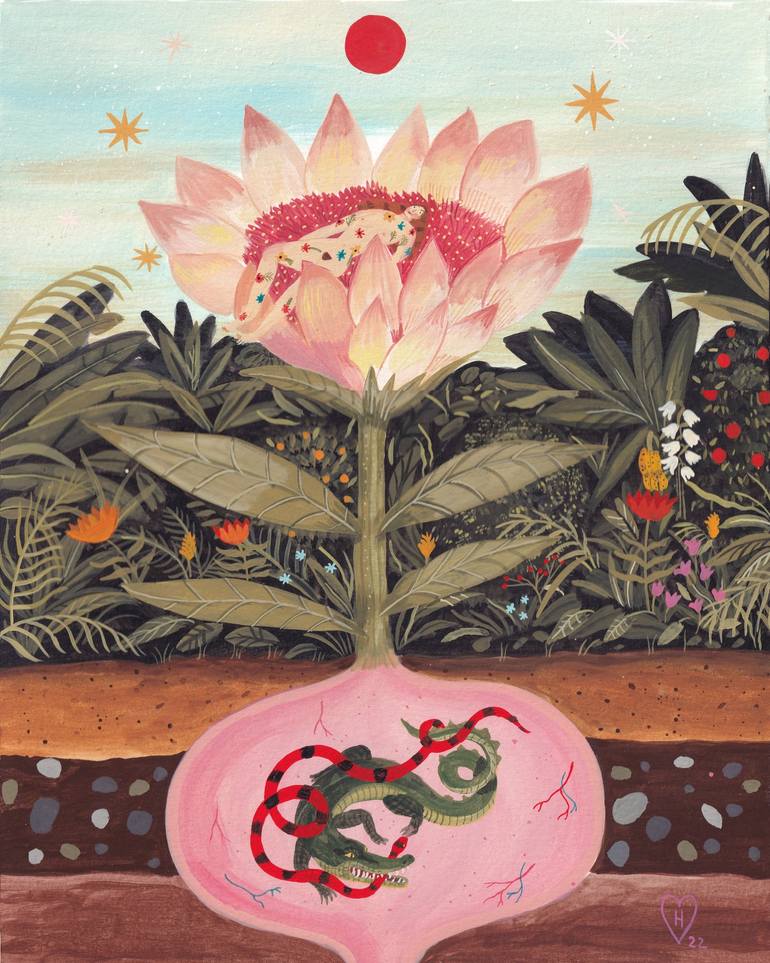
In the Jungian system, there are four ways of using symbols in order to create meaning and depth in your life. The first way is as a tool for dialogue with unconscious content and its integration it into consciousness. The second way is to heal experiences of trauma or loss. The third way is to use symbols to imbue your life with meaning and magic. And the final way is to use symbols to resolve conflict and manifest conscious intent.
1. Symbolising unconscious content in order to make it conscious
Symbolic meaning is found in the external world through the projection of unconscious content onto various objects. Objects here refer in the broadest sense to anything that you project onto, whether it is a person, a movie, a picture, a vase, a song, a company, an event or anything really. When there is an emotional response to something, e.g. you really like it, or you really hate it, or it stays with you for days/weeks/months, this usually indicates that there is unconscious content within your psyche that has found meaning in that object. The object represents more than what it appears to be “objectively”. There is something unconscious within you that you have placed outside of yourself because you have not taken conscious ownership of this idea/concept/belief/dream/goal.
To use a simple example, imagine you are walking through a market and find a stone carving. You hold it in your hand, and it seems as if it is vibrating with energy. You love the shape and colour. You simply have to buy it. If you don’t buy it, the loss seems to remain with you for a long time. This object is a symbol. The meaning is a mystery since it is unconscious. If you worked with this symbol and used your imagination to play with it, you will realise some of the unconscious content that you have projected onto it. It may represent any number of things that you desire – meaning, power, individuality, identity – anything really. The magical process here is in uncovering this symbolic meaning and integrating it into consciousness.
This is part of the process of individuation, Jung’s ultimate goal. To become yourself, unique and whole, requires this type of symbolic work since it unearths hidden truths and desires about yourself which will help you to understand and ultimately manifest who you really are: the most authentic, whole and complete version of your individuality.
2. Using symbols for healing
Symbols can play a powerful role in the process of healing and recovery. The human condition is littered with experiences of loss and trauma. Everyone will experience losing a loved one, or losing themselves, or losing their health. That is inevitable. In this world nothing lasts forever. Yet, we are not prepared when it happens and we often have no idea how to process it. It certainly cannot be fixed by attending a weekend workshop.
People who have suffered the loss of a loved one or loss of health and find themselves stuck and unable to shift, need to move through the loss and distress to find meaning and purpose. This movement requires a symbolisation of their experiences. Carl Gustav Jung said that we yearn for meaning to escape the awful, grinding, banal life where we are reduced to “nothing but”. He further stated that an invaluable tool in creating meaning is symbolisation. What does this mean though? How do we symbolise our experiences to take meaning from them?
The most basic form of symbolisation is the act of speaking about your experiences. Just telling your story to someone else is cathartic and healing. The act of speaking moves the pain and trauma from yourself and your own experience to a story that is both unique to you and also part of the collective condition of being human. The act of speaking about it makes your feelings and emotions about the experience conscious. Emotional pain isolates, and no one can really know or understand how you feel, but in telling your story of your pain, you will express it, compare it to something, give it words and a name and a description. This process is an act of symbolisation.
Take the following passage by Jonathan Safran Foer, for example:
"He awoke each morning with the desire to do right, to be a good and meaningful person, to be, as simple as it sounded and as impossible as it actually was, happy.
And during the course of each day his heart would descend from his chest into his stomach.
By early afternoon he was overcome by the feeling that nothing was right, or nothing was right for him, and by the desire to be alone.
By evening he was fulfilled: alone in the magnitude of his grief, alone in his aimless guilt, alone even in his loneliness.
I am not sad, he would repeat to himself over and over, I am not sad.
As if he might one day convince himself.
Or fool himself.
Or convince others–the only thing worse than being sad is for others to know that you are sad.
I am not sad.
I am not sad.
Because his life had unlimited potential for happiness, insofar as it was an empty white room.
He would fall asleep with his heart at the foot of his bed, like some domesticated animal that was no part of him at all.
And each morning he would wake with it again in the cupboard of his rib cage, having become a little heavier, a little weaker, but still pumping.
And by the mid-afternoon he was again overcome with the desire to be somewhere else, someone else, someone else somewhere else.I am not sad."
Of course this was written by a gifted writer, but you can see the power in the symbolism of the imagery. He is explaining something that many people experience but cannot express. The writing contains the isolation, sadness, anguish and physical distress that this person is dealing with on a daily basis. In his telling of his narrative, he doesn’t cure it, but he names it, describes it, and comes to understand the physical and emotional impact and quality of his experience. The words themselves take on symbolic meaning. It is now possible for him to relate to this experience in a different way, because he has changed his perspective on it. He has created something from his pain, and in sharing this, he empowers others who may be able to relate to these feelings.
A further step to using symbolism for healing is to find a symbol that can pull you through your current experience of distress. Any event experienced that has a profound impact on us has a physical/material and obvious element to it, but it also affects us on a more subtle, unconscious level. This unconscious trauma takes its toll on us in many ways and it is often impossible to consciously realise the effects of this trauma. When you are in distress, your psyche will naturally be attracted to a symbol that can heal you and move you through your distress. Jung said that the most serious psychological crises cannot be overcome but only outgrown. This is the goal of the symbol. Many people find this solace in nature or being with animals. Some have a dream or a numinous experience. But it can be anything: any object that transports you to another place, another time, and a different way of being that contains this magical elixir of healing. The symbol helps you to move beyond your current experience into the future.
The following passage from Clive Barker is a beautiful description of this type of symbolisation:
"I remember a window in a farmhouse in North Wales which had a sill of whitewashed stone so deep I could sit sideways in it at the age of six, hugging my knees to my chin. From that spying place I had a view of the orchard of apple trees behind the house. The orchard seemed large to me at the time, though in retrospect it probably contained fewer than twenty trees. In the heat of the afternoon the farmyard cats, having exerted themselves mousing, went there to doze, and I went to hunt through the unkempt grass for eggs laid my nomadic hens. Beyond the orchard was a low wall, with ancient, mossy stile. And beyond the wall an expanse of rolling meadow, grazed by sheep, with the sea a misty blue prospect.
I have little way of knowing how accurate these memories are; well over forty years have passed since I was small enough to sit in that window niche. The photographs my parents took of those distant summers are still pasted in the musty pages of my mother’s album, but they are tiny, black and white, often blurred. There are, it’s true, a couple of pictures of cats dozing. But none of the orchard, or the wall, or the meadow. And none of the windowsill where I sat.Perhaps it doesn’t matter how accurate my memories are; all that matters is how powerfully they move me. I still conjure that place in my dreams, and when I wake I have the details clear in my head. The smell of the night-light my mother set on the dresser in my bedroom, the dapple beneath the trees, the warmth and weight of an egg found in the grass and carried into the kitchen like unearthed treasure. The dreams are all the evidence I need. I was there once, blissfully happy. And though I cannot tell you how, I believe I will be there again."
Not only does the writer describe a happy memory, but you can see the level of magic and meaning he imbues the memory with. He also relays how he will be there again. This memory contains the elements of happiness and contentment that he desires. A simple story saturated with symbolism that will help him to overcome obstacles he would otherwise struggle to move through.
3. Using Symbolism to Create Meaning and Magic
Jung said that universal human experience is shared and relayed through story and myth. Each of us are living our own myths, and there are experiences and events that shape our myth. As a human being, we are confronted by situations that are archetypal in nature. These events occur, sometimes only once, other times repeatedly. Depth psychology attempts to help an individual to bring the unconscious influence and beliefs into consciousness. When we speak of depth psychology, in other words, psychology that deals with the unconscious component in our psyches, we talk about therapy that addresses this unconscious component and its effects on the individual. Jung offers a way of exploring these archetypal patterns and experiences through symbolisation. To symbolise your unique experience in the world, you can relate your story to a myth, a song, a movie, a book, a picture, a painting or even a dream. This form of symbolisation transforms your personal experience from a pedestrian, meaningless story into a myth, containing a magical, numinous quality. It will contain your experience and your story in a deeper, more layered way, filled with potential and meaning. Myth contains this layered meaning as well and the power of myth is found not only in the stories from Greek and Roman mythology, but in modern-day stories as well. Any story that stays with you contains something which you are unable to consciously express. These are wonderful gifts from the unconscious.
To explain this concept by way of example, I would like you to think of a movie that you have seen or a book that you have read that you often think of. It could even be from when you were a child or a young adult. Reflect on the similarities between that story and your own life. What about the characters in that story? Who do you relate to? Who are the allies or enemies of the main character? Are you the main character, or do you relate to someone else in the story? There are so many ways to delve into the meaning of this story, and you may be surprised by what it reveals to you about yourself and the path that you are on in your own life.
4. Using Symbols for the Manifestation of Goals and Conflict Resolution
The final aspect of symbolisation is the active engagement with your unconscious in order to receive from it symbols for specific goals or the resolution of problems. This is not to be confused with signs. In other words, creating a symbol is not the same as the positive thinking approach to goal achievement, e.g. making collages of your dream house or driving the Porsche you want.
Working with symbols allows the unconscious aspects of yourself to be accommodated within your conscious goals. The symbol also contains the unknown aspects of a problem that you may be dealing with. So, for example, a typical situation that you may want to use a symbol for is to resolve a conflict with a colleague at work. The first step with this type of symbol creation is to know what you want consciously. Depending on the situation, what is the ideal outcome that you want? Once you have decided what it is you want, you keep this objective in your mind and then wait for the unconscious to give you a symbol. This is usually an image, but it could be a song or an object too. It is very important to note that you cannot assign a symbol but need to receive it from the unconscious. This usually happens within seconds of the conscious intent being stated: you will see it in your mind's eye — even if it is just a flash, grab hold of it. If you get a symbol that you don’t like, don’t try to change it. This is the correct symbol, and you need to work with it. The symbol itself contains information about your problem, and reflection on it often reveals something to you that may change your perspective on the situation.
The symbol contains a resolution that is appropriate and takes into consideration the unconscious, unknown factors that have an effect on your situation. In this example, you may not know what is going on with the other person who is giving you a hard time. They are projecting something onto you or dealing with a personal situation that is causing them to behave the way they do. The symbol takes this into consideration. Something else that you can consider is interacting with the symbol through an active imagination. I will write another post about this at a later stage. You do not need to reflect on or keep the symbol alive by thinking about it constantly. Once it has been identified through consciousness, it is unstoppable. There is a warning here: do not create symbols unless it is really important. They are powerful and will affect your reality. Use with discretion.
I challenge you to try this and share with us the resolution or outcome. You are also welcome to ask any questions you may have in the comments section below.
Working with symbols in any of these four ways will add value, meaning and depth to your experience of yourself and the world.