
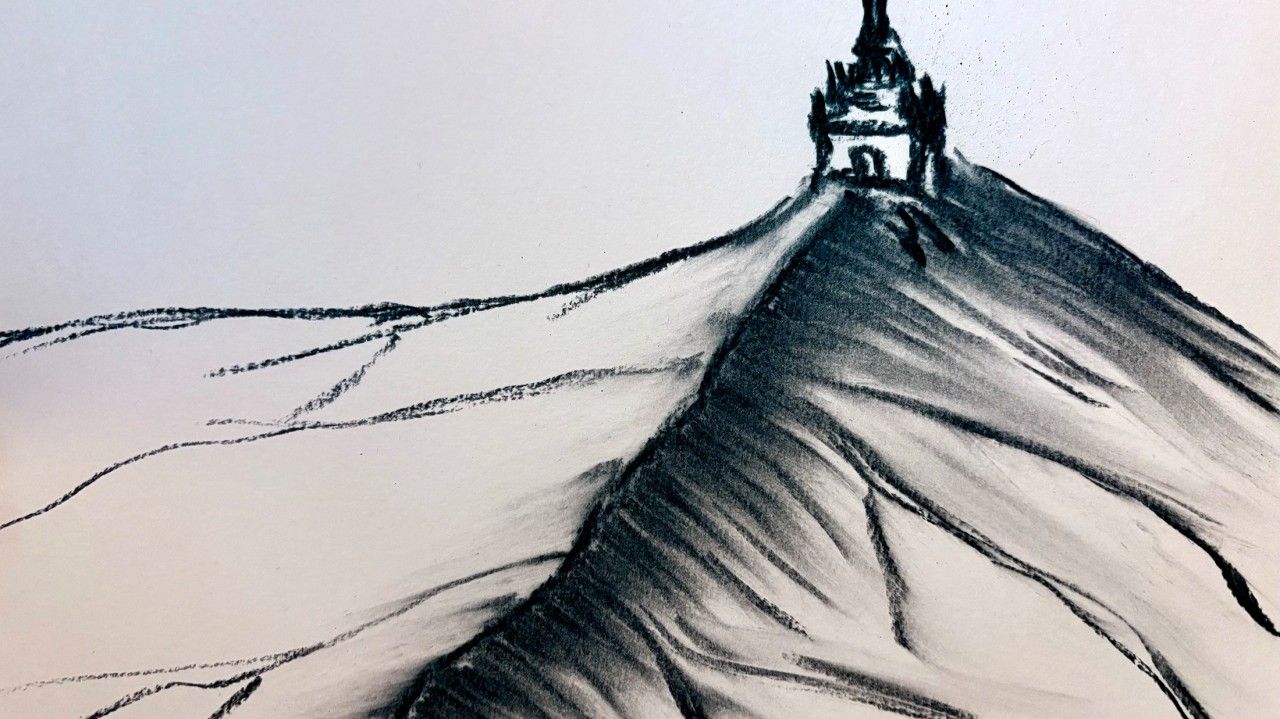
In December (2025) I was fortunate enough to visit the Landscapes of the Soul exhibition at the National Swiss Museum in Zurich. This was
curated and displayed to mark the 150th anniversary of C. G. Jung (1875–1961)’s
birth. It was an eclectic and unusual exhibition, but one that I personally
found quite imaginatively provocative. It located Jung’s work alongside other
visionary artists and the early pioneers exploring the psychic landscape. It
presented a rich and carefully curated exploration of the relationship between
inner psychic life and visual form, with the thought of C. G. Jung serving as a
clear conceptual anchor throughout. Rather than treating landscape simply as a
depiction of the external world, the exhibition positioned it as a symbolic
field in which the structures of the psyche became visible. In this sense, the
exhibition was less about geography than about interiority, less about place
than about psychic space.
Jung’s influence was evident not only in the thematic framing of the exhibition but also in the way the works were arranged and interpreted. The underlying premise was distinctly Jungian: that images arising in art, like those arising in dreams or active imagination, are not arbitrary but are expressions of deeper archetypal patterns. The landscape, in this context, became a privileged site for the emergence of such images. Mountains, forests, rivers, and horizons were no longer just neutral features of the natural world but also symbolic forms through which the psyche articulated itself. They were, in other words, expressions of the inner landscape and interiority of the artists.
It was here that the exhibition’s dialogue with the work of
Henry Corbin became particularly relevant. Corbin’s notion of the mundus
imaginalis—the imaginal world—provided a useful framework for understanding
what was at stake in these works. For Corbin, the imaginal is neither purely
subjective nor purely objective, but occupies an intermediate ontological space
in which images possess a kind of reality of their own. This world is accessed
not through sensory perception alone, nor through abstract reasoning, but
through the imaginative faculty. It is a world in which symbolic forms are
encountered as real presences, capable of mediating between the visible and the
invisible.
The landscapes in this exhibition could be understood as
belonging to this imaginal realm. They were not simply representations of
physical places, nor were they merely projections of individual psychology.
Rather, they existed in a space where inner and outer realities intersected. In
this sense, the exhibition could be seen as an exploration of the mundus
imaginalis in visual form. Jung’s concept of the image as an expression of the
psyche and Corbin’s idea of the imaginal world converged here, offering complementary
ways of understanding how images function as mediators of meaning.
The curatorial approach reinforced this perspective by
encouraging the viewer to engage with the works not only as aesthetic objects
but as symbolic forms. The exhibition invited a mode of viewing that was closer
to what Jung described as active imagination, in which the viewer entered into
a dialogue with the image. Rather than seeking to decode the work in purely
intellectual terms, the viewer was encouraged to respond to it as a living
presence, allowing its forms and atmospheres to resonate on a psychological
level. In this way, the act of viewing became itself a kind of participation in
the imaginal world.
Another important aspect of the exhibition was its attention
to atmosphere. Many of the works relied on subtle variations in light, colour,
and composition to evoke particular moods. A mist-filled valley, a storm-laden
sky, or a quiet expanse of water could carry a strong emotional charge,
suggesting states of calm, tension, or longing. These atmospheric effects were
not incidental but central to the expressive power of the works. They
demonstrated how the landscape could communicate through feeling and tone,
rather than through explicit narrative. From a Jungian perspective, such
atmospheres could be understood as manifestations of psychic states,
externalised in visual form.
The exhibition also highlighted the role of the viewer in
completing the meaning of the work. If the landscape was already an expression
of the artist’s inner world, then the viewer’s response added another layer of
interpretation. Each viewer brought their own associations, memories, and
emotional responses, creating a dialogue between the image and the observer. In
this sense, the imaginal space opened up by the artwork was shared rather than
private. It became a site of encounter, where different subjectivities could
meet.
In bringing together these various strands, Landscapes of
the Soul offered a compelling account of the landscape as a medium of psychic
expression. By placing Jung’s ideas at the centre of its conceptual framework,
and by implicitly engaging with Corbin’s notion of the imaginal, the exhibition
moved beyond a purely formal or historical understanding of landscape painting.
It presented the landscape as a dynamic and symbolic field, in which the
boundaries between inner and outer, subjective and objective, were continually
negotiated.
For students of the psyche, the exhibition provided an opportunity to think about art in a broader and more integrated way. It suggested that images are not simply objects to be analysed but are forms of experience that can engage us on multiple levels. By approaching the landscape as an imaginal space, we were invited to consider how art can function as a bridge between different dimensions of reality, and how it can open up new ways of understanding both the world and ourselves.
I found myself enriched by this artistic expression of interiority and the proverbial landscapes of the soul. It also located Jung, rightfully I would argue, not only as a pioneering psychologist, but also as a mystic and visionary; expressing, as best he could, through his work, something of the ineffable. I think it is a great pity that the exhibition did not receive more publicity, and I sincerely hope the curators might consider future exhibitions of the works displayed. Whilst imperfect and provisional, I thought the exhibition opened up a pioneering space in the exploration of the convergence of the psychic and imaginal in the artistic medium, as well as better locating Jung as a cultural phenomenon.