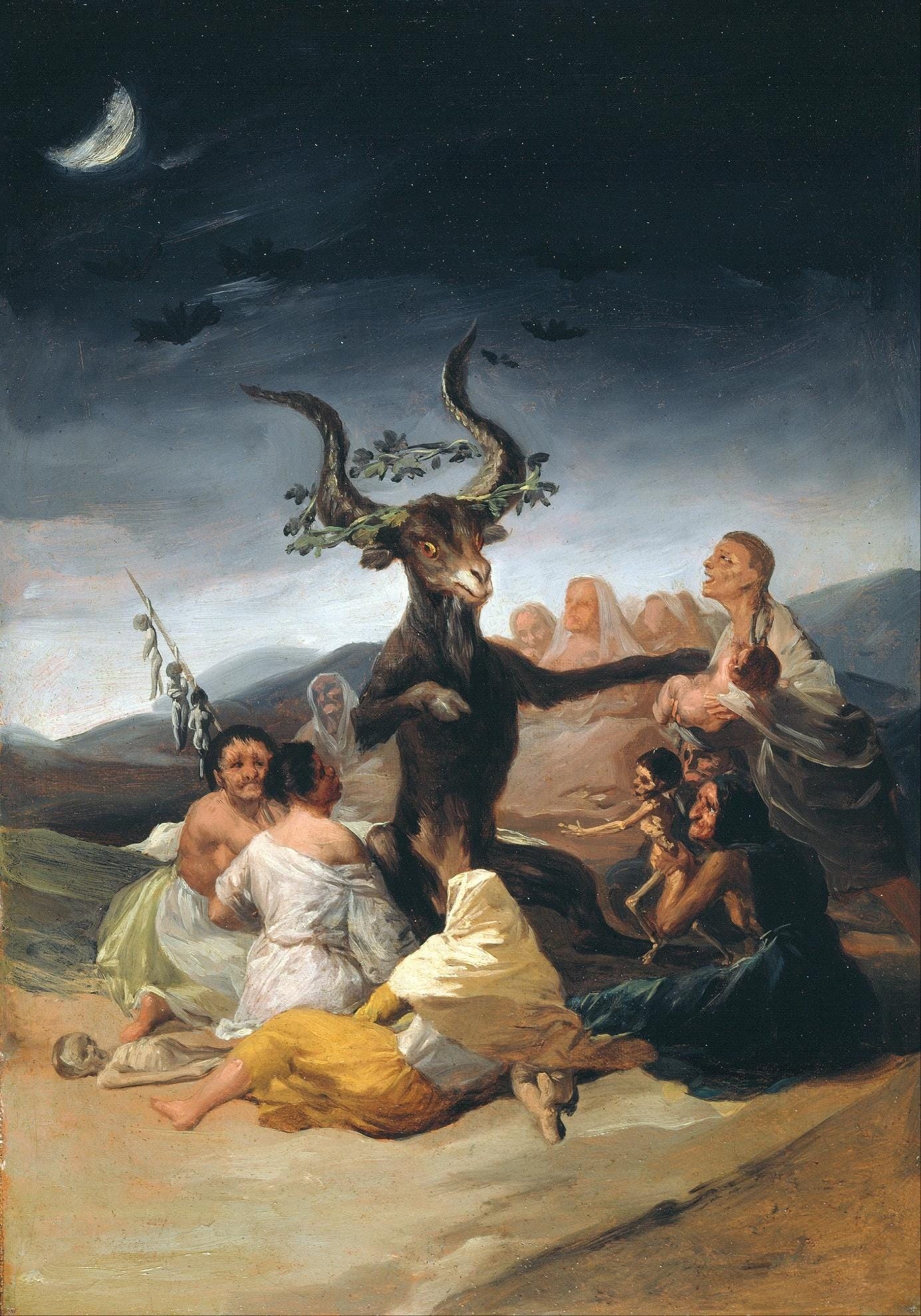
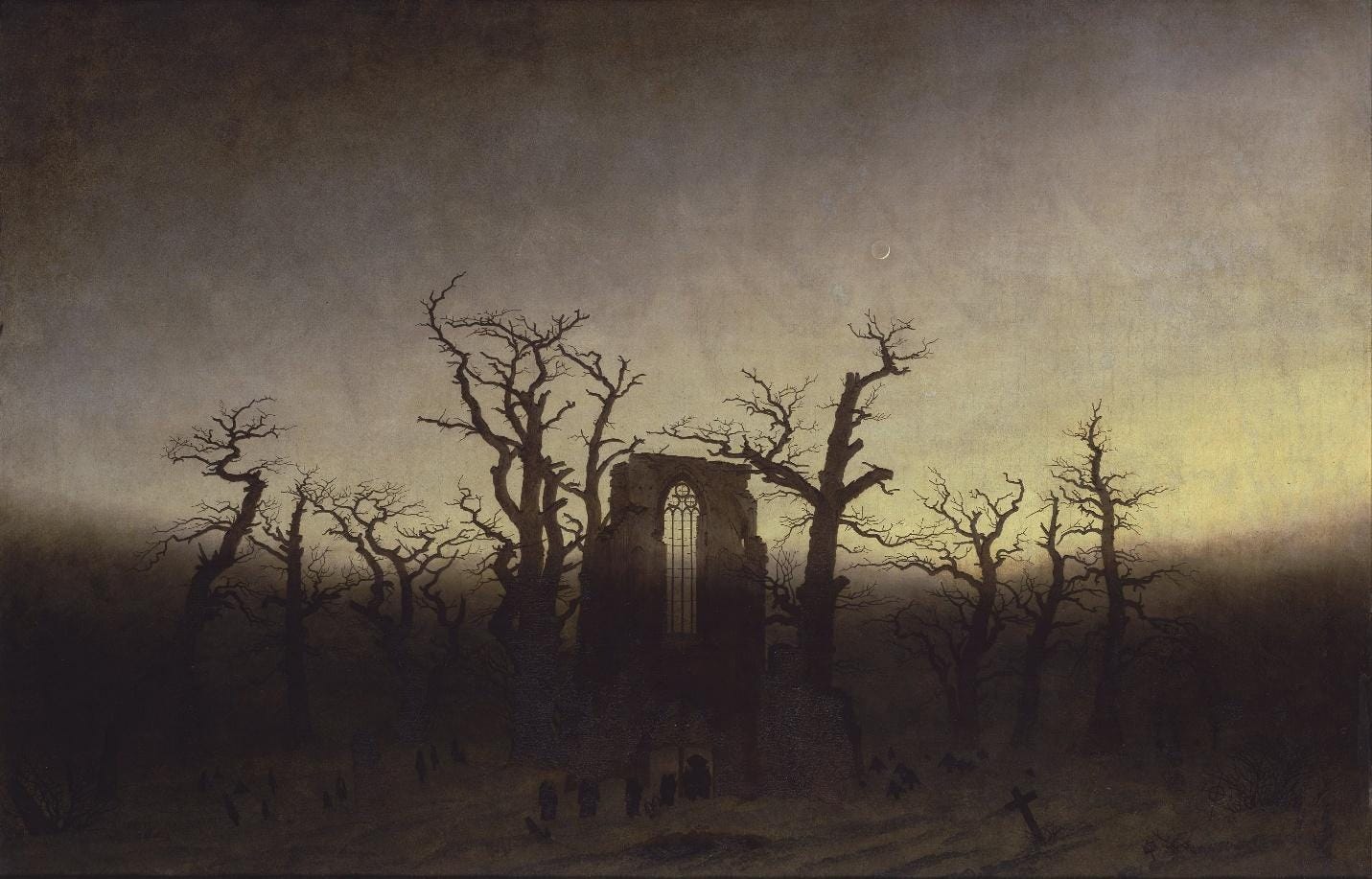
Francisco Goya, Witches’ Sabbath, 1798 Every October, in strip malls and empty warehouses across much of the world, something curious happens. Adults stand in long lines in the cold, pay for pricey tickets, and walk willingly into the dark to be terrified. Children who still sleep with a nightlight beg for scary stories. Netflix fills its front pages with everything that is evil, haunted, and grotesque. I’ve frequently wondered what was behind the exuberant celebration of all that we otherwise abhor, fear, and avoid. It seems to be an old appetite. What’s more ancient than a good ghost story? It suggests to me that it is answering something deep in the psyche. I think the Jungian tradition has a word for what that something is, and it might shed some light on the allure of the darkness. It was contributed by a German theologian who went looking for the holy and found something else underneath it. In 1917 Rudolf Otto published The Idea of the Holy (Das Heilige in the original German). His thesis was a bit radical. The word “holy” had come to mean something like perfectly good, morally spotless, saintly or sanctified. Otto thought this was a later sense of its meaning and that it had obscured a much older and stranger one. Beneath the ethical sense of the holy, he suggested a raw experience that could not be reduced to any degree of goodness at all. He referred to this as the numinous, from the Latin numen for a divine presence or power. What lay beneath the numinous, thought Otto, was the mysterium tremendum et fascinans. The terrifying and alluring mystery. It makes us tremble, is overwhelming, unapproachable, and charged with an energy that dwarfs us. And it is also fascinans. It draws us in and compels us against every instinct. Repulsion and attraction at the same moment. That paradoxical doubleness is how we recognize it. It’s something that anyone who’s stood in a queue at a haunted attraction knows well. Otto traced the earliest form of this experience to what he called daemonic dread. It’s the primitive tingle in the presence of the uncanny, the hair rising on the back of the neck, or the sense of being watched that you occasionally feel in an empty room. He didn’t think any of this was superstition to be outgrown. He thought it was the seed from which awe, reverence, and ultimately worship grew. Significantly, he thought it was something those higher forms of spirituality never outgrew. Even more significantly, he put fear and reverence not just in the same category but in the same container. Anyone who’s spent any time studying Jung is familiar with the concept of the numinous. Otto’s term was used by Jung in his Terry Lectures and published as Psychology and Religion where he describes the numinosum as a dynamic agency or effect not caused by an arbitrary act of will, which seizes and controls the human subject, who is, in Jung’s words, “always rather its victim than its creator.” (Jung, CW 11 ¶6) So for Jung, the defining feature of a numinous experience is that the ego does not bring it about. It arrives, it overpowers, and it terrifyingly reveals to the ego that it is not in charge. Jung assigned this characteristic to his notion of archetypes. When an archetype is constellated, we don’t have an experience, but rather an experience has us. Jung didn’t think this juxtaposition of fear and the holy was just a curiosity of religious experience. In wrote that the main interest of his work lay not in the treatment of neuroses but in the approach to the numinous, and that this approach was real therapy. The psyche, he thought, has an inherent religious function and a need to be in relationship with something greater than the ego. Furthermore, that need does not dissipate when one’s religious belief does. It only goes looking elsewhere. (Jung, letter to P. W. Martin, 20 August 1945, C.G. Jung Letters, Vol. 1.) Where does it go? Perhaps we’re closing in on the mystery here. In his commentary on The Secret of the Golden Flower, Jung offers one of his most quoted lines about how the gods have become diseases. Zeus, he said, no longer rules Olympus but the solar plexus. The powers that once had temples, festivals, and priesthoods have not died. They have been demoted and driven underground, and they now announce themselves as phobias, compulsions, and panic in the night. (Jung, CW 13 ¶54) I don’t think it’s too much of a leap to say they’ve also become entertainment. If the numinous is no longer approached in sanctuaries and temples, it will be approached somehow, and one of the places modern culture has made for it is the horror story. The presence in the empty room, the thing that is wholly other, and the dread that grips the body are all hallmarks of the tremendum. And whatever it is that keeps us returning to the dark and walking deeper into the haunted house is the fascinans. Caspar David Friedrich, Abbey in the Oakwood, 1810 What, then, is our soul seeking when it buys a ticket? I think it’s looking for exactly what Jung described - an encounter with something larger than the ego that will return it to its proper size. It seems like one thing we leave horror with is humility. Against the monstrous, we’re put back down to size. Symbolically, the monster is very like the part of our psyche that is not under our conscious management. Jung’s complexes behave in this way too. They have their own wills, are seldom invited, and take possession (a curiously common horror trope) of us. Our shadow, the repressed and unlived portion of our personalities, shows up in our stories wearing a costume because the ego refuses to take a look at it anyplace else but “out there.” I think it’s possible that some part of us knows this, and that the draw of the monster is in fact the unconscious effort to force our attention on something we’re not yet willing to acknowledge about ourselves. I think that’s what we long for in horror. The ghost and the demon allow us to look at what we’d rather not see in ourselves, briefly and from a safe enough distance. And from a safe enough place. That is, a socially acceptable one. The vampire’s insatiable hunger, the werewolf’s uncontrollable rage, and the possessed child speaking who isn’t herself aren’t creatures from somewhere else – or at least not only from somewhere else. They are exaggerated, grotesque portraits of the appetites, fury, and repressed voices that live in all of us. This isn’t new work. For most of human history, people had places set aside for exactly this kind of encounter: temples and shrines, sacred groves and caves, and festivals for the dead when the boundary between worlds was thought to grow thin. Halloween itself is a remnant of this. It began as All Hallows’ Eve, the night before a holy day, and is often traced further back to the Celtic festival of Samhain. In those older settings, people went deliberately to meet the powers that frightened but also drew them in. Ritual gave the trembling a form, a meaning, and a community to hold it. I think what we’re doing in the haunted house, the theater, and the campfire ghost story may be a substitute for what we once did in temples and shrines. In a way, we’ve preserved the ritual and lost the sanctuary. Or have we? We still line up in the dark, still pay our offering at the door, still come out shaken and strangely grateful. Or humbled. We just no longer have a name for what we went to meet. It seems the religious function Jung described is still finding its way to the sanctuary even if we’ve forgotten – or just refuse to acknowledge - where we’re going. Everyone becomes a believer on Halloween night.
____________________________________________________________________________ Andrew Lavin is an Applied Jungian Practitioner and ICF-credentialed Jungian depth coach. His practice, Chiron’s Cave, focused on individuation, shadow work, and the recovery of soul. He brings more than two decades of executive leadership experience to his work with clients navigating the deeper questions of identity, vocation, and meaning.
Login or sign up to start learningLogin to start learning
Start learning
or
Sign up to The Centre for Applied Jungian Studies!