
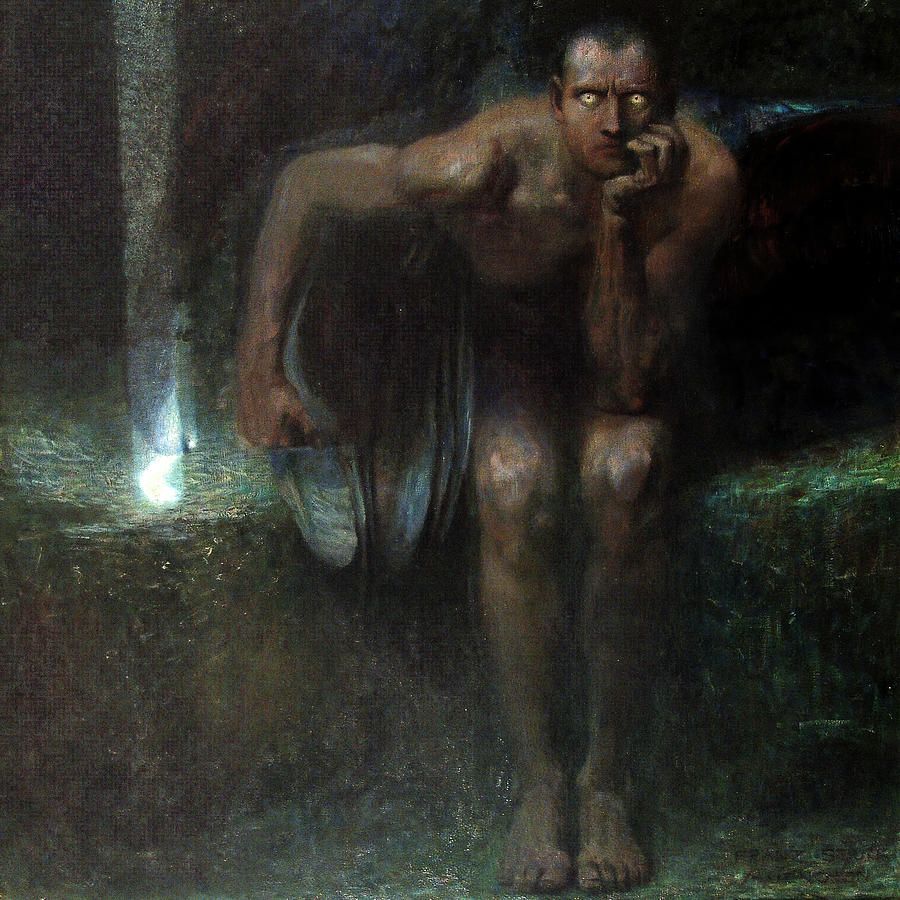
And yet, I want to resist the version of this idea that has become almost fashionable in certain psychological and spiritual circles, which is the notion that the shadow is essentially a misunderstanding, that once you do the work, you'll discover everything in the bag was innocent all along, just waiting to be validated and released into the sunshine. Uncovered treasure.
Some of what's in the bag is genuinely dark. The rage that went underground didn't lose its capacity for destruction just because it became unconscious. The envy, the cruelty, and the will to dominate are all real. They are part of us. Jung was clear on this, and so was Bly. The shadow contains not only what was unfairly suppressed, but what is genuinely savage, truly antisocial, and profoundly dangerous if acted out - whether consciously or unconsciously.
It’s the answer to this question that sets shadow work as serious psychological and spiritual development as opposed to superficial moralizing or shadow work that confuses comfort for true transformation. The answer, I think, is rather simple. Which is not to say that it isn’t extraordinarily difficult.
Integration doesn't necessarily mean expression. It doesn't mean that once you've acknowledged your capacity for cruelty, you're licensed to be cruel. What it means, rather, is that you develop a relationship with what's there. You stop pretending it isn't. You stop expending the enormous energy it takes to keep it locked away, which paradoxically gives it more power, not less. You bring it into the light of consciousness. You know it. You sit with it. You understand what it wants, what it's protecting or hiding, and what wound it grew up around. Not as experienced from or projected onto others - but in you.
The author of this post is Andrew Lavin. He’s an ICF-credentialed Jungian depth coach and the founder of Chiron's Cave, a depth coaching practice focused on individuation, shadow work, and the recovery of soul. He brings more than two decades of executive leadership experience to his work with clients navigating the deeper questions of identity, vocation, and meaning.
That version is comforting. It is also, I think, not quite true. There is also rot amongst the treasure. Jung cautioned on the ontological reality of evil.
Some of what's in the bag is genuinely dark. The rage that went underground didn't lose its capacity for destruction just because it became unconscious. The envy, the cruelty, and the will to dominate are all real. They are part of us. Jung was clear on this, and so was Bly. The shadow contains not only what was unfairly suppressed, but what is genuinely savage, truly antisocial, and profoundly dangerous if acted out - whether consciously or unconsciously.
So, what does reclamation actually look like for that material? Should it be? Can we rather discard it? Toss it to the side? Lighten our load?
It’s the answer to this question that sets shadow work as serious psychological and spiritual development as opposed to superficial moralizing or shadow work that confuses comfort for true transformation. The answer, I think, is rather simple. Which is not to say that it isn’t extraordinarily difficult.
Integration doesn't necessarily mean expression. It doesn't mean that once you've acknowledged your capacity for cruelty, you're licensed to be cruel. What it means, rather, is that you develop a relationship with what's there. You stop pretending it isn't. You stop expending the enormous energy it takes to keep it locked away, which paradoxically gives it more power, not less. You bring it into the light of consciousness. You know it. You sit with it. You understand what it wants, what it's protecting or hiding, and what wound it grew up around. Not as experienced from or projected onto others - but in you.
The American country singer Johnny Cash understood this intuitively, even if he wouldn't have used the language. He cultivated a “Man in Black” persona, which he described explicitly in one of his songs as an intentional choice to wear the darkness rather than hide it. It was not a performance of evil, but rather a conscious owning of it. His addiction, his rage, his capacity for self-destruction were real. He didn't pretend otherwise, and he didn't mask them in his music or his public life. What he did was bring them into relationship with his equally real capacity for charity, faith, and the theme of redemption. It was exactly that integration that became the source of his creative power. Audiences didn't connect with Cash in spite of his darkness. They connected with him because of what he did with it, which ultimately was not dark. The shadow, made conscious and owned honestly, became the very thing that made him extraordinary.
There's a reason Bly draws so heavily on myth and fairy tale in his work - which he does beautifully. The old stories conveyed things we've culturally forgotten: that the dangerous figures like the trickster, the wolf, or the witch are not always enemies to be destroyed. They are powers to be reckoned with, and ultimately, to be integrated. There's a difference between a person who doesn't know their capacity for rage and a person who does. The latter has a choice. The former does not. And it’s in the consciousness of choice that integration of shadow lies.
Consciousness, in this sense, is the real work. Not in the moralistic sense of making you a better-behaved person, but in the deeper sense of making your choices actually yours. When the shadow remains unconscious, it acts through you without your knowledge or consent. You become a puppet in a matrix of influences of which you’re unaware. You project it onto others, you act it out in ways you later can't quite explain, you are, quite literally, not fully in charge of yourself. Making it conscious doesn't eliminate the darkness, but it makes you its master. An imperfect master, no doubt. But no longer a servant.
This is the terrain that CAJS' Applied Jungian Academy explores in its current module on the Shadow. Consistent with their mission, The Academy doesn't approach this as theory only. It approaches it experientially in a way that asks something of you, as authentic Shadow work necessarily does. What disturbs and unsettles, also opens up and expands.
What you find in the bag may not all be welcome. Some of it will be. Some of it will be harder to sit with. But here is what I've found, both in my own work and in the work I do with others: the encounter with the shadow, honestly undertaken, tends to produce something that begins to look less like shame and more like relief. The relief of no longer having to maintain a fiction. The relief of meeting yourself more wholly. Bly suggests that when we begin to retrieve what we've put in the bag, we don't just recover something lost. We recover energy. What Jung called psychic libido. Those who do this work describe feeling more alive. Not lighter, necessarily. Unlike its metaphorical equivalent, the shadow carries weight. But it's a lot more efficient and convenient to carry it around as a conscious companion than drag it behind us.
The Centre for Applied Jungian Studies’ Applied Jungian Academy is currently exploring the Shadow as part of its ongoing 24-month curriculum in depth psychology and individuation. If this kind of serious, sustained engagement with your own psychological life is something you're drawn to, you can find more information about the Academy here.
The author of this post is Andrew Lavin. He’s an ICF-credentialed Jungian depth coach and the founder of Chiron's Cave, a depth coaching practice focused on individuation, shadow work, and the recovery of soul. He brings more than two decades of executive leadership experience to his work with clients navigating the deeper questions of identity, vocation, and meaning.