
A tool to identify your transference: understanding your unconscious communication in relationships
May 1
Transference- countertransference, Lacan, Jung
Transference, as a technical term in depth psychology, describes the process whereby unconscious content is shared between patient (analysand) and analyst in the context of their therapeutic relationship (analysis). Although used to refer to this specific relationship dynamic in analysis, transference is a very real dimension of all social interaction; it is by no means limited to the analytical couple (analyst and analysand).
This is the third in a series of three short articles I have written on transference–countertransference. The other two can be found by following these links:
In this article, I want to share a tool with you that you can use to identify what your transference is, i.e. what it is you are transferring (unconsciously communicating) in your relationships. This is something worth knowing, as it provides a very clear insight into why people respond to you as they do. The transference is a virtual instruction manual to the other as to how you should be (and want to be) treated. There is an old aphorism that says something like, “Don’t wear your heart on your sleeve.” The rather uncomfortable truth, though, is that this is exactly what we all do, and there is absolutely nothing we can do to avoid this. Before you say a single word or do a single thing, in fact, before you have even met the other, you have already exposed your heart to them. Your heart is fully transparent in all its beautiful hues and ugly blemishes.
Not only is it transparent to the other, but far more so than it is to you. What is opaque to your inner gaze is clearly visible to the gaze of the other. So before we begin, please understand that this is the simple (if awful) truth that every psychoanalyst has known for the last century or so, and many mystics before them. There is nothing I can offer you that will change that. What I can offer you is something that, although more modest, can nevertheless be quite useful – the ability to see in yourself what the other sees, to understand the content of your unconscious communication. Continuing down this path of full disclosure, let me add that knowing what your transference is most definitely does not imply being able to magically change it. I can almost guarantee you that you will not like much of what this tool will show you – assuming you apply it with honesty and some imagination.
What you transfer, according to the reams of research done in psychoanalysis, is typically a primal relationship dynamic. That is the relationship with your primary caregivers (usually your parents, of course), and this is not subject to change by pure force of will. It is not governed by your conscious will or self; it is rather, in the spirit of depth psychology, an unconscious dynamic and one very deeply rooted in your psychology. So I can say with a fair degree of certainty that this will resist the best transformational intentions of the weekend workshop industry in its various guises and affiliations.
You may reasonably enquire at this point what then the point of such an exercise is exactly if what is discovered is not subject to change by your (conscious) willing? This is a fair question, and let me attempt a fair answer. Whilst the recalcitrant nature of the transference is undoubtedly true, 1) there are both immediate benefits in identifying it; and 2) it is subject to intentional evolution if you are willing to do the work of intense self-reflection over an extended period of time. It would be true to say here that many roads lead to Rome; any system of rigorous and intensive self-reflection in an open and self-critical system can enable an evolution of this primary wound. The typical way, and still possibly the best, to approach this is to enter analysis – and in this respect I am non-partisan, it doesn’t matter whether you end up with a principally Freudian or Jungian analyst. We, The Centre for Applied Jungian Studies, offer an online programme called Magnum Opus, that is designed to teach the tools of self-analysis either as an alternative to formal analysis or as a useful addition.
The immediate benefits in knowing what your transference are:
Knowing what it is will help you to better navigate your relationships, both in terms of managing yourself and in managing your expectation of the other and the relationship’s outcome or Telos (its destination, target trajectory, etc.).
You cannot overvalue the immensity of consciousness. Being conscious, even when it is not of a Promethean nature (the magical ability to use consciousness to change reality), is an immeasurably better position to be in than the original unconscious state. That is to say, consciousness has infinite value in itself, independent of any practical utilitarian value that it may offer.
The Tool
The tool I am going to share with you is one we developed at the Centre; it is an adaptation of a Lacanian idea. Although our primary influence is Jungian[1], we also utilise the work of Freud[2] and Lacan[3] to create a system of applied psychodynamics. In this case, we are applying a model developed by Lacan in his work on The Four Discourses[4]. We will proceed in three steps:
Step 1 introduces the original Lacanian model that has been adapted to create the tool;
Step 2 shows the first part of the adaptation and justifies why such an adaptation can be made;
Step 3 reveals the tool itself and the guidelines on how to use the tool.
Step 2 shows the first part of the adaptation and justifies why such an adaptation can be made;
Step 3 reveals the tool itself and the guidelines on how to use the tool.
My suggestion is that you read all three steps very carefully before attempting to apply the tool to your own case.
Step 1
The model was developed by Lacan as a way of representing certain typical forms of social interaction, specifically the discourses (organisation of communication) of the Master, the University, the Analyst, and the Hysteric[5]. This model that very usefully asks the question: what is the “truth” of each of these communications, what desire (primary motivation) drives these discourses.
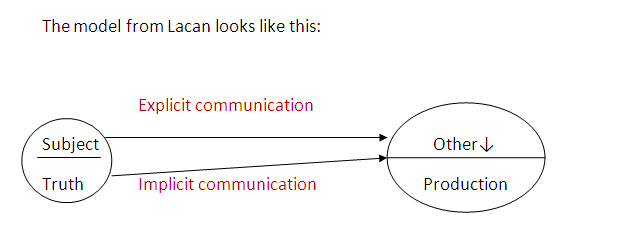
The subject is the protagonist in the discourse; in this case it serves as a placeholder for you. You are the subject.
The truth is the (actual) reason you are in the discourse; it cashes out as your desire, what you desire from the other.
The other is simply the person you are in the discourse (relationship) with.
The production is what is produced by the discourse; where does the discourse lead? How is your desire met or not met? It is produced by the combined effect of the explicit and implicit communications by the subject on (directed towards) the other.
The explicit communication (represented by the horizontal arrow between the subject and the other) is what you say you want/mean/intend, etc. Your spoken communication.
The implicit communication (represented by the bottom arrow between the Truth and the other) is the actual reason you are in the discourse – what you really want.
So, as an example, when “the Master” is placed in the place of the subject, he addresses the other as a “Slave”; his discourse, irrespective of its explicit content, is designed to fulfil his desire. The other is dehumanised insofar as they are seen strictly in their functional role, not as a person. The desire, “the truth,” has to do with the other (the functionary) fulfilling their function, which is the production of some service for the Master. Anyone in a hierarchical contractual or employment situation in discourse with an employee is an example of this.
I, as Master, retain your services as Slave (functionary) to fulfil my desire, the job I have employed you for, but social protocol often disguises this very clear hierarchical situation. So, in other words, frequently the explicit discourse is not: “do your job and thereby fulfil my desire”, but something along the lines of: “take pride in your work”; “you are doing so well….”; “you can do better/more/faster etc.”; “this is an important job”, and so on.
Now, in the example of the Master’s discourse, it is important to understand that the presence of the “truth” does not deny the significance of the explicit communication. So just because the Master’s implicit communication is the fulfilment of his desire by virtue of the production of the functionary (the other), does not invalidate the significance of the spoken explicit content – both are valid, and both serve to further the desire of the subject, in this case, the Master.
Step 2
We have adapted this model as a means of getting at the transference in any social encounter. The logic behind this adaptation is quite simple:
The “truth” is always an implicit (unspoken) form of communication that needs to be arrived at inferentially. When one is in a discourse with the Master, for example, there is an implicit (or inferential) understanding of the Master’s desire, irrespective of the exact content of his communication. This is the same as the transference in that the transference has to be inferred; it is not explicit, it requires an intuiting or inference of the desire (or truth) of the subject in relation to the other.
The truth is occupied in the Lacanian model by desire, i.e. the truth is just the subject’s desire; the transference mirrors this in that the transference is also an expression of unconscious desire.
The truth may or may not be unconscious (the transference is typically, although not always, unconscious). However, there is strong resonance between the unspoken implicit desire contained in the “truth” and the transference. The “truth” is socially and institutionally repressed in that it remains unspoken (it becomes a silent truth), this is very much the nature of the transference.
There is a frequently compensatory relationship between the explicit and implicit communications in the Lacanian model. There is a form of compensation in the explicit communication of the Master that disguises his (avaricious) desire; it may be friendliness, politeness, or even anger, but all of these disguise (compensate) in some form his desire. The transference shares this feature; conscious communication is typically a compensation for the contents of the unconscious, which populate the transference.
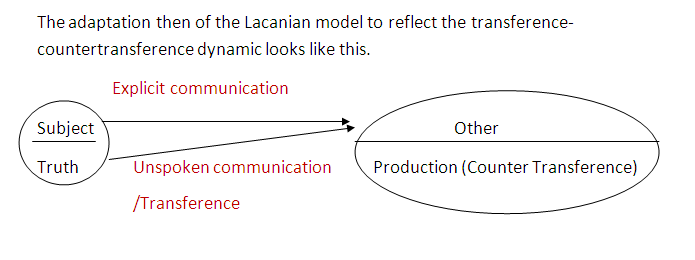
So, very simply, what we see here is:
The “Truth” becomes a synonym for the transference,
The reaction by the other (the Production) is the countertransference. The countertransference is the response by the other to the contents of your combined explicit and implicit communication, what you say and what you transfer.
The above being noted, in psychoanalysis, we typically believe that the transference acts as an unconscious communication which speaks with far more authority in terms of your relational expectations than what you actually say. Hence, the word “truth” here is telling – the transference tells the other the “truth” of your desires, irrespective of what you are saying.[6]
Step 3
The way in which we use this model to construct our tool is through a triangulation of two knowns and one unknown. What we know is the explicit spoken communication and the Production (where the relationship leads), which is the countertransference. What we do not know, but want to get at using this tool, is the transference – our unconscious communication.
The tool then looks like this:
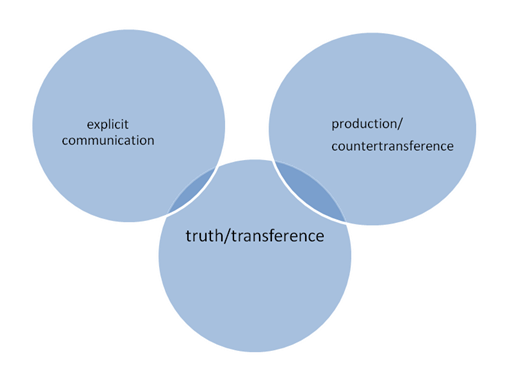
The first thing you do is populate the production/countertransference field. Then, once you have done this, you need to populate the explicit communication field. These are the two knowns that you have to work with and from which you will infer the third field, which is the truth/transference field. So this is a 3-step process:
Step 1: Describe in a few clear and concise sentences what the result of the relatedness is, where it leads, which is (in this model at least) the countertransference e.g. let us imagine a discourse taking place between a married couple where the production is one of discord, conflict, unhappiness, criticism and a general lack of love and kindness by the other towards the subject.
Step 2: As before, describe in a few clear and unambiguous statements what is explicitly communicated. Going back to our example above of a discordant married couple, let us imagine that the subject explicitly communicates to their partner their desire for love, kindness, and a peaceful coexistence.
Step 3: Populate the last field, the truth/transference field. This is done through a process of combined logical inference and creative imagination[7].
You will need to bring your creative imagination to the party, but I can help you draw out the inferences. The principal clues the model provides are:
You will need to bring your creative imagination to the party, but I can help you draw out the inferences. The principal clues the model provides are:
The contrast between your explicit communication and the production or countertransference.
Assuming you are considering a challenging relationship dynamic, the chances are that the reason it is challenging is that there is a stark contrast between your expressed (explicit) desire in the relationship and what actually happens (the production or countertransference). Using the example of the married couple in an unhappy relationship. Seemingly, there is something counterintuitive in the contrast between the expressed desire of the subject (let’s say, in the example, the wife) and what actually happens. In this case, the product is the opposite of her stated desires and intentions. This suggests immediately that the transference is fundamentally different from the explicit communication. We don’t yet know what it is, but that contrast is strongly suggestive of it being quite distinct and possibly opposite to the explicit communication.
The second clue is that the transference is typically a far more authoritative voice when it comes to telling the other what the nature of your desire really is.
Once again, I do not mean to dismiss the authority and significance of the explicit communication, but not only psychoanalysis, but also everyday experience, teaches us that we pay far more attention to the authority of the transference (the unconscious communication) than we do to what is said.
Imagine, for example, someone is trying to sell you a product; consider how you evaluate the sales pitch. Is it what the salesperson says or is it what you feel, sense, or intuit, whilst you are listening to their sales pitch? Two salespeople could approach you selling the exact same product and using not dissimilar sales pitches, and yet you are far more inclined to buy from the one than the other- that is the authority of the transference. So, in terms of applying this tool, you can reasonably infer that your transference will map onto the product (the countertransference) with a greater degree of congruence than any other pairing in the triangulation, i.e. explicit communication-product; or explicit communication-transference.
Another clue is the principle of compensation from psychoanalysis.
What we know from psychoanalysis is that the unconscious and conscious minds share a compensatory relationship with each other. This has the implication that much of what we say and do is done in order to compensate for an unconsciously experienced opposite. This is seemingly quite perverse, but it is a cornerstone of psychoanalytic theory. A joke that Freud would tell was of the patient who arrived at her first session and blurted out, “We can discuss anything but my mother!” One need hardly be a psychoanalyst to recognise that she has identified exactly where the analytical conversation needs to go, which, quite obviously, is the exact opposite of what she has said. In terms of the application, then you can reasonably assume that there is a relationship of compensation between your explicit communication and your unconscious desire that populates your transference.
Now it is not an exact one-to-one opposite. The compensation can be quite subtle, so this is where a certain degree of imagination and sensitivity is required to identify exactly what it compensates for in you. In our hypothetical example of the married couple, we might speculate that although the wife claimed she desired love, kindness and peaceful coexistence, an unconscious impulse in her actually desired the opposite, which was (at least partly) responsible for the product of discord and unhappiness. This “wound” would typically have a developmental origin, being traceable back to one or more of her primary relationships as a child.
Another clue: The transference typically expresses a desire. Bear this in mind in your analysis of your own transference. Desire here, though, can be subtle in that one can well desire misery as much as one may desire happiness; unconscious desires have this perverse element about them.
The language of the unconscious does not share the sophistication of your conscious spoken communication; it expresses itself in simple, often quite crude terms. So when trying to identify your transference, avoid subtle “clever” phrasings and favour blunt expressions.
Conclusion
I hope that I have provided you with enough to apply this very powerful tool to your own situation and relationship challenges. It is not, I must admit, the easiest of applications, but I assure you that it is one worth putting some effort into. The insights it can provide can quite literally change your life and help you better navigate relationship challenges that have been frustrating you for years.
If you find yourself simply unable to effectively penetrate into the transference, my suggestion is to recruit a partner for the exercise; and even if the exercise comes quite easily for you, there is always a benefit in doing it with one or two others.
If you find yourself simply unable to effectively penetrate into the transference, my suggestion is to recruit a partner for the exercise; and even if the exercise comes quite easily for you, there is always a benefit in doing it with one or two others.
As I said at the beginning of this article, recognising the transference does not entail its transformation. If you want to change the transference, this requires serious reflection and work on the nature of the transference. It is however, the critical first step on the road to more meaningful and satisfying relationships.
If you would like to understand the role of your unconscious dynamics in your relationships more fully and spend some time working on them consider joining us for Citrinitas which stats this Monday the 21st of September.
Citrinitas
If you would like to understand the role of your unconscious dynamics in your relationships more fully and spend some time working on them consider joining us for Citrinitas which stats this Monday the 21st of September.
Citrinitas
[1] Carl Gustav Jung (1875 – 1961) founder of analytical psychology.
[2] Sigmund Freud (1856 – 1939) father of psychoanalysis.
[3]Jacque Lacan (1901 – 1981), the French psychiatrist and psychoanalyst
[4] Lacan, Seminar XVII, 1969
[5] Lionel Bailly, (2009), ‘Lacan’, pp. 153 – 162
[6] Obviously, this does not grant any right per se (or certainly not any legal right) to the other to ignore your explicit communication. Although, as we all know, typically what happens is that people do not listen as much to what we say as to what we really feel (the proverbial content of our heart).
[7] Psychology being both an art and a science.
Join Our Newsletter
Stay informed about upcoming courses, special offers, and curated learning opportunities from the Centre for Applied Jungian Studies.
Thank you!
Explore
About the Centre
Copyright © 2026. The Centre for Applied Jungian Studies.
Site Design by Sean Corey.
Site Design by Sean Corey.
Copyright © 2026