
I’ve been pondering dreams and their interpretations recently since it’s the topic of this month’s Applied Jungian Academy. Looking over my bookshelf, a title caught my attention, perhaps because of the season. The Dream and the Underworld, by the late Jungian analyst James Hillman. I’d read it years ago, recalled it as dense and difficult book, and had left it with a sense that there was much more there than I had gathered. I pulled it out and relived my reading of it in the manner I occasionally do - my own “abridged” edition consisting of my highlighted passages and marginalia.
The Dream and the Underworld is billed on its cover as the “first new view of dreams since Freud and Jung.” Marketing hyperbole, perhaps. On the other hand, not to be entirely dismissed, I don’t think. Hillman’s thesis is that the dream does not belong to the day at all. It belongs to the underworld, and the psychology it serves is not the psychology of living well, but the psychology of dying. Hillman attacks head on the central way that we approach dreams in the west: with the question, “What does it mean?”
It is such a natural question that we rarely notice ourselves asking it. Most of what we refer to as dream interpretation begins with the assumption that the dream is a kind of letter from the unconscious, written in symbolic code, and that our job is to decode it and act on what it says. It might be a calling to a new career, or a warning to call your mother, or a suggestion to pay attention to your anger.
Hillman proposes something far more profound. And, he thinks, far older.
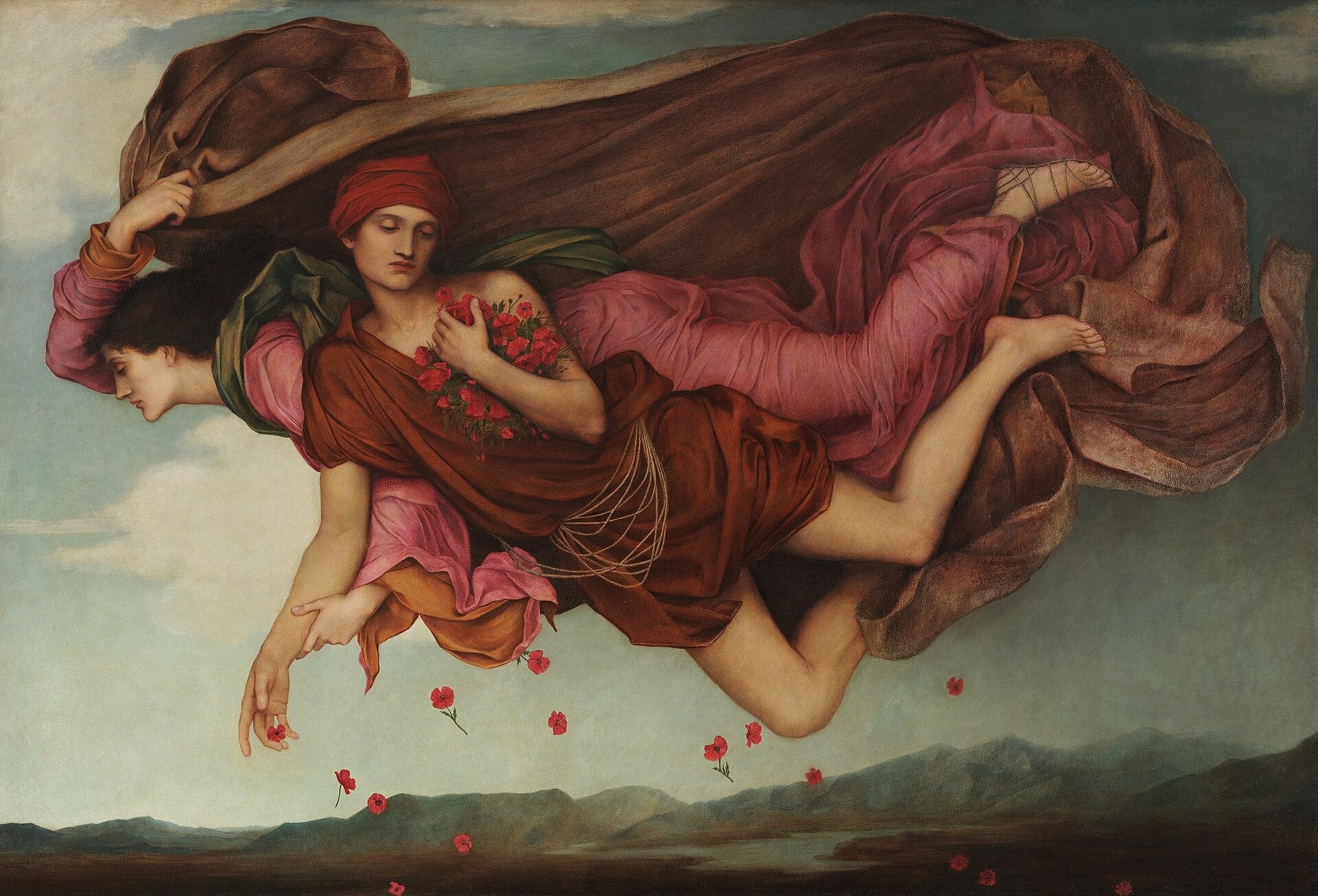
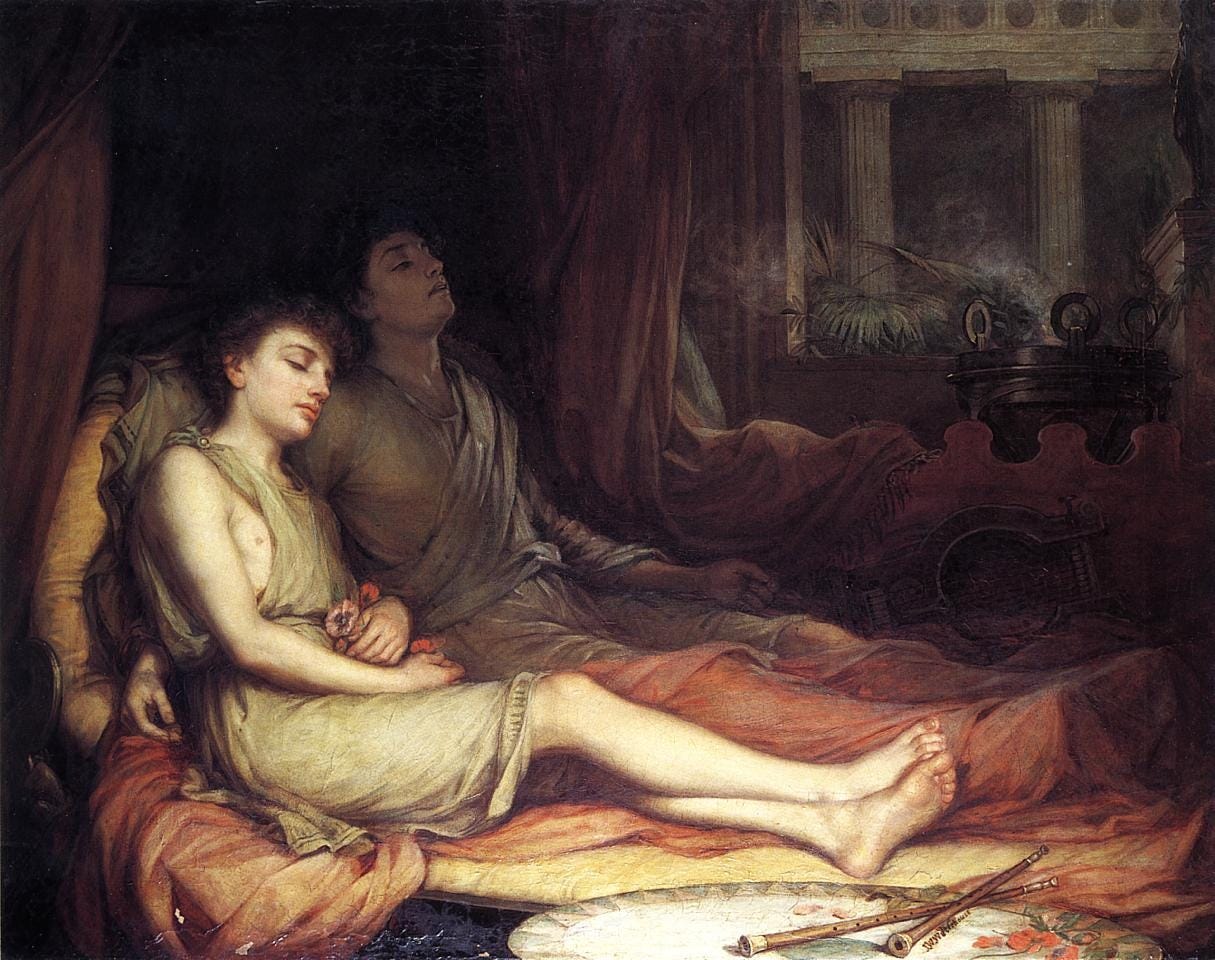
The ancient Greeks, Hillman suggests, encoded the significance of dreaming in the relationships of their gods. In Hesiod’s Theogony, Sleep and Death, Hypnos and Thanatos, are brothers. To go to sleep was to travel toward the place the dead go, and the figures who met you there, the shades, were understood not as people but as images. They are likenesses without bodies, forms without flesh, recognisable but no longer living the material life of the day.
Hillman is not claiming that dreams are literal visits to the land of the dead (although he never quite closes the door on that either, I don’t think). He claims that the underworld is a perspective, a way of seeing in which things are experienced as soul rather than as matter. The ancients regarded Hades as something like “the unseen one”. He’s the god of what lies beneath appearances, the in-visible depth inside every visible thing. To enter Hades is to stop asking what something is for and to begin asking what it is, in itself, in its depth.
Dreams, in other words, are underworld experiences because they are pure image. Nothing in a dream has a body. Your dream mother, for example, is not your mother. She is an image of your mother, a shade of her, and she exists according to the laws of that place, not this one. To relegate your dream mother as nothing but a symbolic representation of your “real” mother is to shortchange her. In a sense, it’s to put the dream mother in service to your real mother. And Hillman thinks that undermines her.
Here Hillman departs significantly from both of his primary predecessors. Freud took the dream to be a disguised wish. Later, Jung imagined it to be compensation, the psyche’s way of balancing a conscious attitude that has grown one-sided. Hillman respects both views. But he makes us aware that they share a direction of travel. In each case, the dream is carried up out of the night and translated into something relevant to our day life. Into what the dreamer wants, or lacks, or needs to do next. He uses the metaphor of building a bridge, but his critique is that the traffic on it only runs one way.
Freud’s and Jung’s ideas of wish fulfillment and compensation are useful. In my work with clients, I watch them open things up many times. All the time, in fact. But they still treat the dream as a servant of waking life, a corrective memo from the unconscious to the ego. Hillman asks what happens if we reverse the flow. What if the day is not the measure of the dream? What if the dream is the measure of the day?
He makes a metaphor out of the story of Heracles journey to Hades. The hero arrives in the underworld, sees the shade of the Gorgon, draws his sword, and has to be told that there is nothing there to strike, that he is swinging steel at an image. Hillman makes of this the heroic ego carrying its daytime habits into a place where they do not apply. He calls dream interpretation done in that spirit a sword drawn on a shade. Futile.
But, if the dream is not a message for the day, what is it? The dream, Hillman says, works on the day. It takes the residue of waking life, the conversations, the worries, the faces, the half-noticed things, and breaks them down, the way digestion breaks down a meal or the forest floor breaks down a fallen leaf. What was literal is dissolved into what is imaginal. The events of today become soul. Perhaps, as Freud thought, the dream does consist of the scraps of our waking life. And perhaps too, we may recognize in them an unfulfilled wish or desire. But, I think, what Hillman is saying is that by making the dream merely a symbol of it, diminishes its significance. Hillman seems to say that the dream, as digested waking life, becomes the fertile ground from which the soul grows.
And this is what he means by the psychology of dying. Not morbidity or a fascination with the grave, but a recognition that every night something of our daytime self and our insistence that things are only what they appear to be, goes down into the dark and is un-made. Every dream is a small death of waking world perspective.
Those of Hillman’s brand new-Jungian thought have a frequently used catch phrase: stick with the image. In other words, instead of being too quick to ask what the dream means, stay with what it shows. For example, stick with the dog rather than replacing him with “instinct” or “loyalty” too quickly. Stay in the house, with its mildewy stairwell and the room you didn’t know was there. The image is not a disguise over a meaning. The image is the meaning, and it will keep working on us for as long as we hold to it, for what it is, rather than trading it too quickly for a “meaning.” Live in the house for a spell, I think Hillman would say. Don’t make it merely a messenger.
I will admit some frustration. As one of my margin comments stated, “Can’t we just enjoy an insight!?” In the end, it seems to me that Freud’s repressed wishes, Jung’s compensatory dreams, and Hillman’s underworld claims are not so much alternatives as they are complimentary paths along the same descent. Perhaps what resonates most about Hillman’s is that we live in a culture that converts everything into use.
What he suggests is simpler than interpretation (as anyone who’s grappled with dreams can attest), but more difficult in practice. To let the dream stay where it lives. To go down to it rather than hauling it up here. To not ask what it wants us to do, but to just be in the place it is taking us, and to live there for a time. And if we bring it back with us, to bring it back as we’d bring back an exotic holiday. We don’t ask what a week in Bali means. But a week in Bali can change us.
This month in the Applied Jungian Academy the topic is dreams and (somewhat ironically) dream interpretation. If Hillman’s descent has stirred some interest, the Academy is always open to new subscribers. Click here to learn more.
Andrew Lavin is an Applied Jungian Practitioner and ICF-credentialed Jungian depth coach. His practice, Chiron’s Cave, is focused on individuation, shadow work, and the recovery of soul. He brings more than two decades of executive leadership experience to his work with clients navigating the deeper questions of identity, vocation, and meaning.