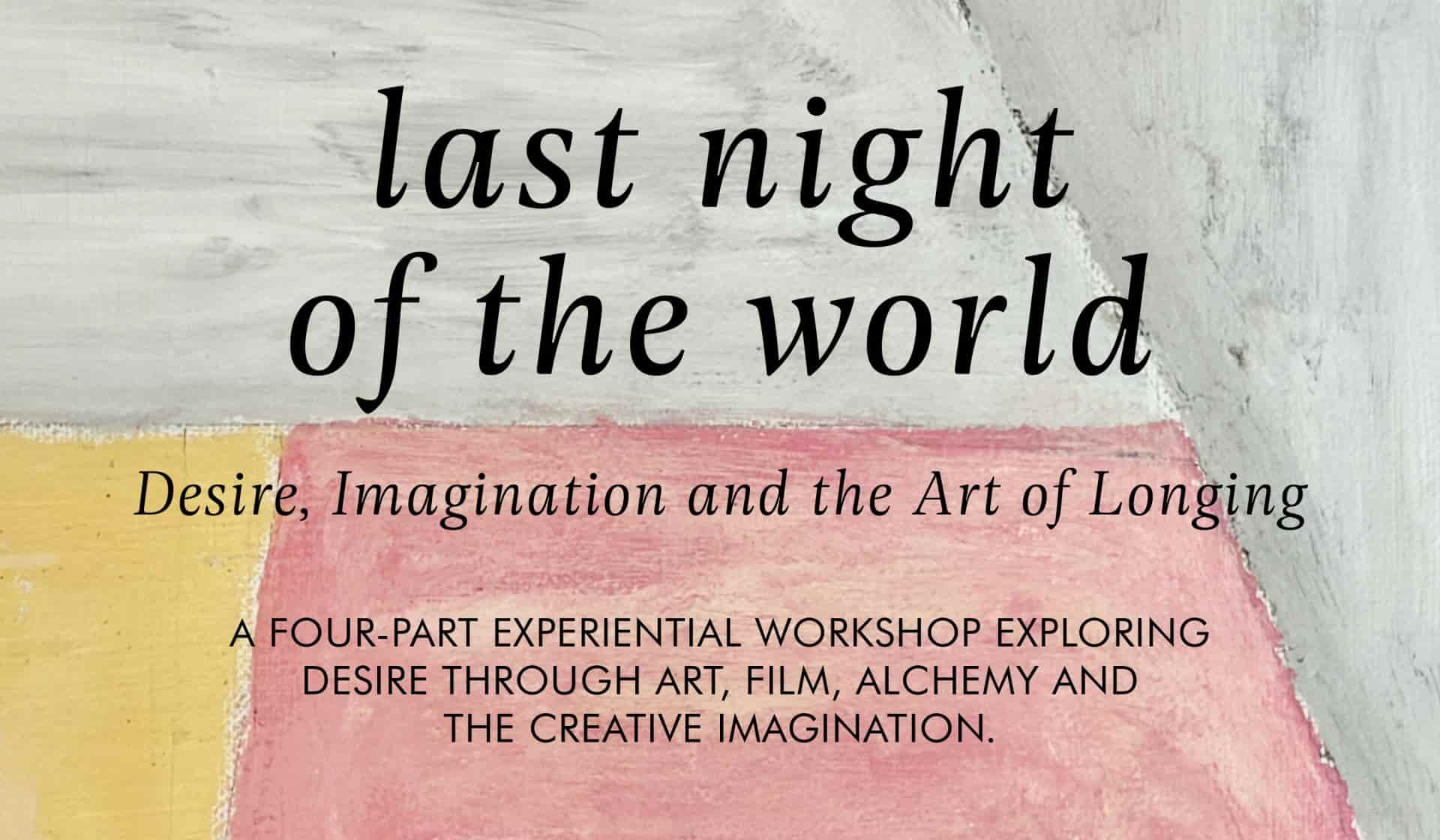
What do we desire when we desire another?What is the place of longing in the life of the psyche?And what might we discover if, for a moment, we allow desire to become an image?
Desire is one of the great mysteries of human experience.
It animates our relationships, inspires our creativity, disturbs our certainties and draws us towards experiences that can change the course of our lives.
We may know very well what we want, yet remain strangely uncertain about why we want it, or what we imagine its fulfilment will give us.
Sometimes desire attaches itself to a person. Sometimes to a place, an image, a possibility, a life we have not lived. And sometimes what we desire most intensely is something we cannot possess, or perhaps cannot even adequately describe.
What, then, is the nature of desire? What gives an image, an encounter or an imagined possibility its peculiar emotional power? And what might our desires reveal about the deeper movements of the unconscious.
Who is this course for?
No artistic experience or technical skill is required. The purpose is to give your imagination an opportunity to engage with desire in ways that ordinary explanation may not permit.
The programme culminates in an invitation to share this work with the group during our final workshop.
Cost: Once-off $190,
or 2 monthly payments of $100
Four live online workshops, each two hours long.
• Friday, 27 November 2026
• Saturday, 28 November 2026
• Sunday, 29 November 2026
• Saturday, 5 December 2026
Time: 8.00 PM –10.00 PM (SAST)/
6.00 PM- 8.00 PM London/
1.00 PM -3.00 PM NYC
Format: Online presentations, guided experiential applications
and group discussion.
These workshops will be recorded.
Presenters
Sue Pam-Grant moves across painting, performance, and writing with a practice that feels both deeply intimate and intellectually charged. Her work lingers in the fragile space between presence and disappearance, where touch, memory, and vulnerability become subtle acts of resistance. Drawing on psychoanalysis, feminist thought, and the Japanese idea of mono no aware, she gives form to the emotional undercurrents we often struggle to name.
Projects like Ichigo Ichie and Last Night of the World:Proscenium Eros Rose unfold as q uiet encounters rather than declarations, holding fleeting moments long enough for them to resonate. There is a tenderness in her work that resists spectacle, insisting instead on attention, care, and the politics embedded in both.
Pam-Grant has exhibited internationally, with recent solo presentations at the Iziko South African National Gallery and the New York Psychoanalytic Society and Institute (2024), and SHE LINES at TPO Wits Gallery (2021). Her collaborative work with William Kentridge includes O Sentimental Machine at the Istanbul Biennale (2015) and I Am Not Me, the Horse Is Not Mine, which toured globally, including the Museum of Modern Art (2010).
More recent performance encounters include 14 734 Dots Between with Yoshi Ikeya in Tokyo ( June 2025) and a solo presentation at the Stellenbosch Woordfees (2024), where she was nominated for Best Solo Performance.
She holds a Master’s degree from the University of the Witwatersrand and has received an honorary doctorate from The Parkmore Institute. Her Doctorate is in Psychosocial Studies/Intervention. Her artist’s books Last night of the World: Proscenium Eros Rose has recently been acquired by the New York Public Library into their Artist’s book Collection. A collection of her artist’s books are also held in the Wits Art Museum, including the Jack Ginsberg Collection, as well as in private and public collections internationally. She is represented by Axis Gallery, New York, Pam-Grant lives and works in Cape Town, South Africa.
Stephen Anthony Farah, MA, is the co-founder and Head
of Learning and Research at The Centre for Applied Jungian Studies South
Africa. He is the past co-Chair of the International Association of Jungian
Studies and served on the IAJS Executive Board for nine years. Stephen holds an
honours degree in analytical philosophy from the University of the
Witwatersrand and a master’s degree in Jungian and Post-Jungian Studies from
the University of Essex. Stephen’s interests include psychoanalysis, film,
psychoeducation, consciousness, individuation, and Future Studies. His
published papers include ‘True Detective and Jung’s Four Steps of
Transformation’ published in ‘The Routledge International Handbook of Jungian
Film Studies’ (2018) and ‘The Freak: in Search of Jung’s second Personality’,
in the anthology ‘The Spectre of the Other in Jungian Psychoanalysis:
Political, Psychological and Sociological Perspectives’ (Routledge 2022), which
Stephen co-edited.
No prior knowledge of Jungian psychology is required in order to participate in this course.
For more information email info@appliedjung.com.